

A national IT company provides managed support, network infrastructure, and systems integration under one accountable provider — covering multiple locations with consistent response standards, specialist routing, and a delivery lifecycle that moves from discovery to ongoing maintenance without gaps.
Most organisations operating across several sites face the same structural problem: too many vendors, inconsistent response times, and no single point of accountability when something goes wrong. A project delivered by one supplier, monitored by another, and supported by a third creates coordination overhead that quietly erodes operational efficiency. The solution is a unified service model where managed IT support, network and cabling projects, and integration work share the same delivery framework and the same team. Impulso Tecnológico has built exactly that model over more than 25 years, serving clients across Spain, Portugal, and 25 countries internationally. The measurable result is a client base of 476 active organisations and over 4,000 IT tickets resolved annually — not through scale alone, but through structured engagement and proactive monitoring that prevents incidents before they reach critical status.
What a National IT Company means for real-world coverage
The phrase "national IT company" is used loosely across the industry. For buyers, it should mean something specific: a provider that maintains consistent service standards regardless of which site raises a ticket, has qualified specialists available across disciplines, and takes single-point accountability for both project delivery and ongoing support. Vague claims of nationwide presence are common; what matters is whether the provider can demonstrate structured enquiry routing, documented response windows, and a multi-service portfolio that does not require you to manage separate vendors for networking, managed services, and integration.
Impulso Tecnológico operates as a national IT company with an international reach — supporting clients in Spain and Portugal on-site, and remotely across Europe, Asia, and the Americas. With over 25 years of experience and more than 476 active clients across 25 countries, the model is built around centralised coordination: enquiries are routed to qualified IT professionals who assess requirements quickly and connect organisations with the right specialists, whether the need is consultancy, managed services, or cybersecurity.
| Criterion | Generic IT Vendor | National IT Company (Impulso Tecnológico) |
|---|---|---|
| Geographic coverage | Single region or city | Spain, Portugal, remote support in 25 countries |
| Service scope | One or two disciplines | Managed services, networking, cabling, cloud, security, integration |
| Response window | Ad hoc or undefined | Structured follow-up within 24–48 business hours |
| Accountability | Multiple vendors, fragmented | Single provider, centralised coordination |
| Languages | Local language only | Spanish and English |
| Annual tickets resolved | Not disclosed | 4,000+ per year |
Nationwide coverage: what you should expect across locations
Consistent coverage across locations requires more than a broad service area claim. It requires that every site — whether a head office, a regional branch, or a remote facility — receives the same quality of specialist routing, the same response standards, and access to the same technical depth. When a network issue surfaces at a secondary location, the response should not depend on whether that site happens to be near a local engineer. Impulso Tecnológico's model addresses this through remote support capabilities combined with on-site availability in Spain and Portugal, and structured escalation paths that connect the right specialist to the right problem regardless of geography. For multi-location organisations, this consistency is what transforms IT from a site-by-site risk into a managed, predictable function. Explore how this applies in practice through our broader range of IT services for businesses.
Service scope alignment: support, network, cabling, integration
Scope clarity is one of the most underrated factors in IT partner selection. Organisations that separate their managed support contract from their network infrastructure projects and their integration work routinely encounter handover gaps — moments where no single provider owns the outcome. A genuine national IT company should be able to handle nationwide managed IT support, network cabling and structured cabling, wireless site survey and network audit, and IT integration and systems integration under one contractual relationship. Impulso Tecnológico's portfolio is structured precisely this way: managed services, cloud (Microsoft 365 and Azure), networking (Cisco and Aruba), security (Sophos, Fortinet, Veeam), and automation (Odoo, n8n, Make.com) are delivered by a single multidisciplinary team. This eliminates the coordination overhead that typically inflates both cost and resolution time when multiple vendors are involved.
Trust signals that reduce selection risk
When evaluating an IT partner, trust signals should be verifiable rather than aspirational. The most meaningful indicators are volume-based metrics (how many clients, how many incidents resolved), geographic delivery proof (actual countries served, not just claimed), certified technology partnerships, and client feedback that reflects communication quality rather than just technical output. Impulso Tecnológico's technology partnerships include Sophos, Fortinet, Veeam, Microsoft, Cisco, Aruba, HP, Lenovo, Dell, Schneider Electric/APC, QNAP, and Verkada — each requiring active certification and ongoing competency. Clients consistently highlight responsiveness and communication clarity as differentiators: being easy to engage with, committed when issues are reported, and transparent about what is and is not included. These are the signals that reduce selection risk for organisations making a long-term IT partner decision. For further context on our approach, see our IT consulting success story.

Services overview: managed IT support, network & cabling, integration
Three service pillars form the architecture of a complete national IT company offering. Each pillar addresses a distinct operational need, but they function most effectively when delivered by the same provider — because the outputs of one directly affect the performance and risk profile of the others. A poorly designed network undermines managed support response times. Fragmented integration creates security gaps that managed services must then compensate for reactively. Impulso Tecnológico connects all three into a single delivery model:
- Managed IT support — proactive monitoring, preventive maintenance, incident handling, and SLA-backed response using Microsoft 365 and Azure managed services as the cloud foundation.
- Network infrastructure and cabling — wireless site survey and network audit, structured cabling (copper and fibre), wireless design and installation using Cisco and Aruba technologies, and ongoing network audit cycles.
- IT integration and systems integration — connecting business applications, automating workflows, and implementing platforms such as Microsoft SharePoint, Odoo, n8n, and Make.com to reduce manual overhead and improve data flow across the organisation.
Centralising these three pillars under one IT partner across multiple locations eliminates the vendor management complexity that typically consumes internal IT resource. It also means that when a new site is opened or an existing environment is upgraded, the same team that designed the network also manages the support contract and handles the integration layer — reducing handover risk and shortening time to value.
Managed IT support: reducing downtime and improving response quality
Proactive IT monitoring and maintenance is what separates managed IT support from reactive break-fix. Rather than waiting for a system failure to trigger a support call, a managed services model monitors infrastructure continuously — identifying degraded performance, failed backups, or security anomalies before they escalate into downtime. Impulso Tecnológico's managed services include preventive maintenance, system updates, remote and on-site technical support, and SLA-guaranteed response windows. The engagement model is structured: clients are encouraged to provide sufficient context upfront (environment details, user counts, compliance requirements such as GDPR, and any critical deadlines) so that the first response is substantive rather than a clarification loop. Follow-ups are confirmed within a structured window — typically 24 to 48 business hours — which means clients move from initial contact to assessed next steps without unnecessary delay. With over 4,000 tickets resolved annually, the volume reflects a mature, repeatable support operation rather than an ad hoc service.
Wireless & wired network expertise: surveys, installs, audits
Network performance is the foundation on which every other IT service depends. A poorly surveyed wireless deployment creates dead zones that disrupt collaboration tools and VoIP. Unaudited cabling infrastructure introduces latency and fault points that are difficult to diagnose remotely. Impulso Tecnológico's network team delivers wireless site surveys (including predictive WLAN design), access point installation and configuration, and structured network audits that document current state and identify risk before it becomes an incident. On the wired side, the team handles network cabling and structured cabling projects across copper and fibre, from initial design through installation and certification. Technologies deployed include Cisco and Aruba for switching and wireless, and Fortinet for network security integration. The result is a network infrastructure that is documented, audited, and aligned with the managed services layer — so when a fault occurs, the support team already has accurate topology data rather than spending the first hour of an incident reconstructing the environment.
Integration and automation: digitalisation with Microsoft and business apps
IT integration and systems integration is where infrastructure investment translates into operational efficiency. Microsoft 365 and Azure managed services provide the productivity and identity layer — email, collaboration, cloud storage, licence management, and conditional access — but the real efficiency gains come from connecting these platforms to the business applications that run daily operations. Impulso Tecnológico supports integration projects using tools such as Odoo (ERP and CRM), n8n, and Make.com to automate workflows between platforms, reduce manual data entry, and surface business intelligence where it is needed. For organisations that have invested in Microsoft SharePoint or Power BI, the team can extend those environments with custom workflows and data connections. This is not a generic "digital transformation" message — it is a practical capability that reduces the time staff spend on repetitive tasks and improves the accuracy of information flowing between systems. For organisations exploring this area, our IT consulting services provide a structured starting point.
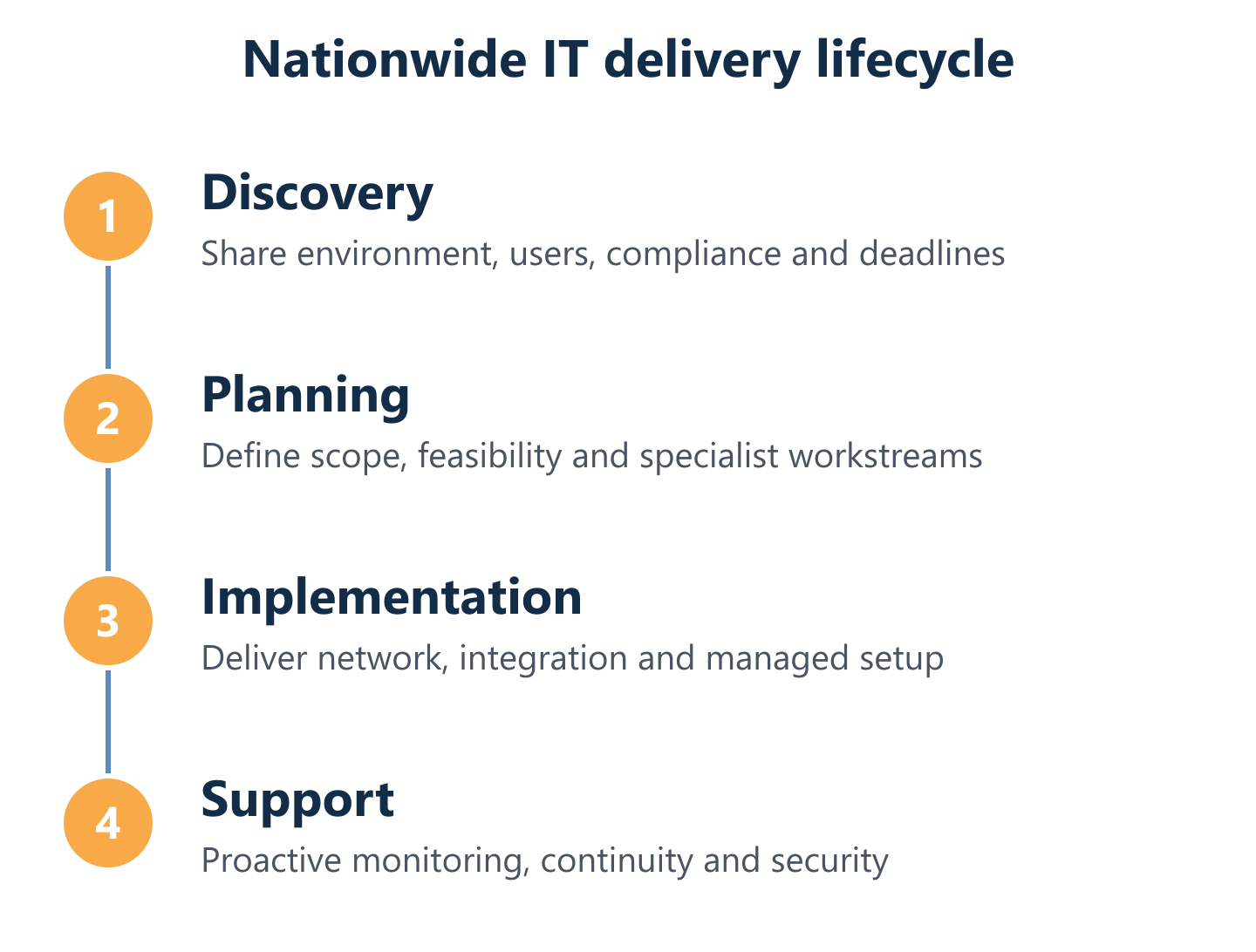
How we work: a clear delivery lifecycle from discovery to support
A delivery lifecycle that is opaque to the client creates friction at every stage — from initial scoping through to post-implementation support. Impulso Tecnológico's engagement model is designed to remove that friction by making each phase explicit and by setting clear expectations about what happens next. The lifecycle covers four stages: discovery and planning, solution design, implementation, and ongoing managed support. What distinguishes this model from a generic project methodology is the emphasis on quality of initial information and structured follow-up cadence.
- Context before recommendations: the team prioritises understanding business context — industry, current systems, user counts, compliance requirements (e.g., GDPR), and critical deadlines — before proposing solutions, avoiding generic answers that require lengthy clarification loops.
- Structured response windows: after first contact, clients receive a substantive response within a defined window (typically 24 to 48 business hours), with confirmation of next steps if acknowledgement has not been received.
- Specialist routing: enquiries are connected to qualified professionals in the relevant discipline — consultancy, managed services, cybersecurity, networking — rather than a generic helpdesk queue.
- Centralised coordination: a single provider manages the full scope, reducing the coordination overhead that arises when multiple vendors are involved in the same environment.
- Measurable checkpoints: SLA-backed response standards and documented service scope mean clients can verify delivery against agreed terms at each stage.
- Continuity by design: the transition from project delivery to ongoing managed support is planned from the outset, not retrofitted after go-live.
Discovery and planning: what to share to speed up feasibility
The speed and accuracy of a feasibility assessment depends almost entirely on the quality of information provided at first contact. Organisations that describe only a symptom — "our network is slow" or "we need better security" — receive generic initial responses. Those that provide structured context move significantly faster through the assessment phase. When engaging with Impulso Tecnológico, the most useful information to share upfront includes: the industry sector and regulatory context (including GDPR obligations where applicable), the current IT environment (on-premise, cloud, or hybrid), the number of users and sites, any known compliance or audit deadlines, and the primary business objective driving the engagement. This is not bureaucratic process — it is the minimum context needed for a qualified IT professional to assess feasibility accurately and propose a realistic next step. Clients who provide this detail at first contact typically receive a substantive proposal faster and avoid the back-and-forth that delays project starts.
Implementation and handover: structured follow-ups and specialist routing
Implementation quality is determined as much by coordination as by technical execution. When a project involves network infrastructure, cloud migration, and security configuration simultaneously — which is common in multi-location deployments — the risk is that workstreams proceed in isolation and create integration problems at handover. Impulso Tecnológico's multidisciplinary team manages these workstreams under a single coordination layer, ensuring that the network team's output aligns with the security configuration, and that both are documented before the managed services team takes over ongoing support. Specialist routing means that each workstream is handled by the right technical resource — Cisco and Aruba-certified engineers for network infrastructure, Microsoft-qualified consultants for 365 and Azure, and security specialists for Sophos, Fortinet, and Veeam deployments. Handover is confirmed with structured follow-up, and clients receive documentation of the implemented environment as a baseline for ongoing support and future audits.
Ongoing managed support: proactive monitoring, continuity, and security
Once implementation is complete, the transition to ongoing managed support should be seamless rather than a renegotiation. Impulso Tecnológico's managed services contracts are structured on a monthly basis with guaranteed SLAs, covering proactive monitoring, preventive maintenance, system updates, and both remote and on-site technical support. The security layer — delivered through Sophos endpoint protection, Fortinet firewall management, and Veeam backup and disaster recovery — operates as an integrated component of the managed services model rather than a separate contract. This means that a security event triggers the same response workflow as a performance incident, with the same specialist routing and the same escalation path. Business continuity is maintained through regular backup verification, documented recovery procedures, and compliance monitoring for GDPR and other applicable frameworks. For organisations that want to understand how this model applies to their specific environment, our computer consulting services provide the starting point for a structured assessment.
Fewer delays, clearer outcomes, and a single point of accountability: these are the practical results of working with a national IT company that operates a unified service model. If your organisation is managing separate vendors for support, networking, and integration — and absorbing the coordination cost that comes with that — the alternative is a delivery lifecycle you can follow from first contact to ongoing managed services. Impulso Tecnológico is that partner. The next step is straightforward: share your environment context, and we will assess feasibility and propose a realistic path forward.