

IT services are the structured capabilities that keep an organisation's technology running, secure, and aligned with business objectives. They cover everything from help desk support and network management to cybersecurity, cloud infrastructure, and ITSM—delivered through defined processes, agreed service levels, and accountable teams.
Most organisations reach a point where reactive, ad-hoc IT support is no longer enough. Systems grow more complex, security threats increase, and the cost of unplanned downtime becomes tangible. The gap between having technology in place and having technology that reliably serves the business is precisely where IT services make the difference. A well-structured IT services model replaces firefighting with prevention: incidents are caught before they escalate, infrastructure is maintained proactively, and every service has a clear owner and measurable output. The result is a more resilient operation, lower risk exposure, and teams that spend their time on core work rather than chasing IT problems.
What IT Services Are (and what they're for)
IT services are not simply a helpline for when something breaks. They are structured, repeatable capabilities that an organisation relies on to plan, operate, protect, and improve its technology environment. The distinction matters: ad-hoc support reacts to problems after they occur, whereas IT services are designed to prevent problems, maintain continuity, and align technology with business strategy from the outset.
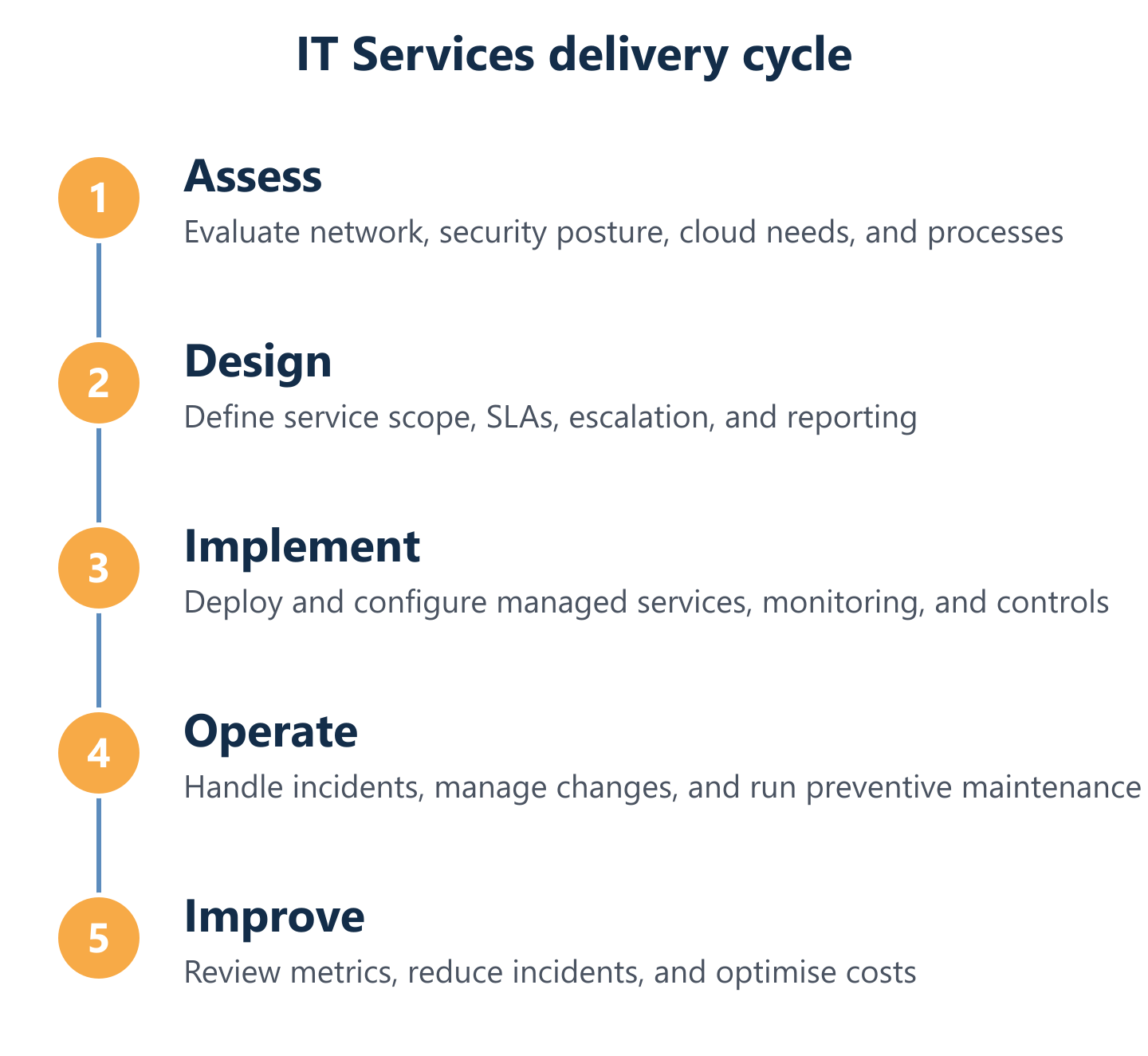
At Impulso Tecnológico, this is precisely how we operate. With over 25 years of experience, we act as an external IT department—planning, implementing, and maintaining IT capabilities so that internal teams can concentrate on their core work. We begin every engagement with an in-depth evaluation of the current environment: network architecture, security posture, cloud needs, software licensing, and operational processes. This consultative approach means recommendations are grounded in actual business objectives and budget, not generic templates.
The table below illustrates how IT services differ from traditional break-fix support across the dimensions that matter most to buyers:
| Dimension | Break-Fix / Ad-Hoc Support | Structured IT Services |
|---|---|---|
| Response model | Reactive—triggered by failure | Proactive—monitoring and prevention |
| Cost predictability | Variable, often unpredictable | Fixed monthly contracts, controlled costs |
| Service ownership | No defined owner or escalation path | Defined roles, SLAs, and accountability |
| Security posture | Addressed only after incidents | Layered, continuous protection |
| Business alignment | Minimal—technology and strategy are siloed | Explicit—services tied to operational goals |
| Reporting and visibility | None or informal | Regular reporting, KPIs, and trend analysis |
Core definition: from support to managed capability
IT services are end-to-end capabilities that run, protect, and improve IT for the business. The word "capability" is deliberate: it implies ongoing delivery, not a one-off fix. A managed IT support capability, for example, does not just answer calls—it tracks ticket trends, identifies recurring issues, and feeds that intelligence back into preventive action.
This shift from support to managed capability is what separates mature IT service providers from simple contractors. It requires defined service scope, documented processes, qualified personnel, and technology tooling that enables monitoring, automation, and reporting. For organisations without a large internal IT team, partnering with a provider that operates this way—as Impulso Tecnológico does across Spain, Portugal, and international clients—delivers the operational depth of an enterprise IT department at a proportionate cost.
Business outcomes: efficiency, security, and customer experience
IT services deliver measurable business outcomes when they combine people, processes, technology, and defined service levels. Efficiency gains come from reduced downtime, faster incident resolution, and automation of repetitive tasks—freeing staff to focus on higher-value work. Security outcomes are achieved through consistent application of controls: endpoint protection, access management, vulnerability scanning, and backup disciplines that limit exposure and recovery time.
Customer experience—both internal (employees) and external (clients)—improves when IT services are reliable and responsive. A well-run managed IT support model means that when a user encounters a problem, the resolution path is clear, fast, and communicated. Organisations that handle around 4,000 IT tickets annually, as Impulso Tecnológico does across 25 countries, develop the pattern recognition needed to reduce incident volumes over time rather than simply processing them.
Service governance: scope, roles, and accountability
A well-defined service scope is the foundation of effective IT governance. It clarifies which services are covered, who is responsible for each component, how incidents are escalated, and what outputs are expected within agreed timeframes. Without this clarity, both the client and the provider operate with misaligned expectations—leading to disputes, gaps in coverage, and unresolved risks.
Service level agreements (SLAs) are the contractual expression of this governance. They specify response and resolution times, availability targets, reporting frequency, and the conditions under which escalation occurs. Effective IT governance also includes change control—a formal process for approving and documenting modifications to the environment—so that improvements do not inadvertently introduce new risks. For organisations evaluating providers, asking to see a sample SLA and a reporting template is one of the most direct ways to assess governance maturity before signing a contract.

Core Elements Behind IT Services
When an IT services description is too vague—"we handle everything IT"—it is usually because the provider has not clearly defined the building blocks that underpin delivery. Understanding these elements helps buyers identify gaps and ask sharper questions during evaluation.
At Impulso Tecnológico, our delivery approach is built on a consultative evaluation followed by a multi-layer security mindset. We cover network and endpoint protection, vulnerability management, penetration testing, VPN and encrypted access, and continuity enablers such as backups and compliance-oriented record management. This structured approach means nothing falls through the cracks between layers.
The five core elements of IT service delivery are:
- People: Qualified engineers, service desk analysts, and account managers who own delivery and communicate clearly with the business.
- Processes: Documented ITSM workflows covering incident management, change control, problem management, and service requests—aligned to frameworks such as ITIL.
- Technology: The hardware, software, network infrastructure, and cloud platforms that the services run on and protect.
- Data: Structured backup strategies, retention policies, and access controls that protect business-critical information and support regulatory compliance.
- Security and continuity: Layered defences—from perimeter firewalls to endpoint protection and disaster recovery—that ensure operations can withstand and recover from threats.
People and processes: ITSM, help desk workflows, and escalation
ITSM (IT Service Management) is the framework that turns reactive support into a managed capability. It defines how incidents are logged, categorised, prioritised, and resolved—and how recurring problems are identified and eliminated at root cause. A mature help desk workflow does not simply close tickets; it captures data that drives continuous improvement.
Escalation paths are equally critical. When a first-line analyst cannot resolve an issue within the agreed timeframe, a clear escalation matrix ensures the right engineer is engaged without delay. For organisations relying on an external IT department, this structure must be transparent: clients should know who handles what, at which tier, and within what timeframe. Impulso Tecnológico operates with defined escalation procedures and bilingual support (Spanish and English), which is particularly important for international teams where communication speed directly affects resolution time.
Technology and data: endpoints, servers, SaaS, and backup strategy
The technology layer of IT services spans every device and platform the organisation depends on: end-user endpoints (laptops, desktops, mobile devices), on-premise servers, network equipment, SaaS applications, and cloud infrastructure. Each component requires lifecycle management—procurement, configuration, monitoring, patching, and eventual replacement—to remain reliable and secure.
Data strategy sits at the intersection of technology and risk. A backup approach that covers only some systems, or that has never been tested for recovery, is not a backup strategy—it is a liability. Robust IT services include tiered backup policies (local, off-site, and cloud), defined recovery time objectives (RTOs), and regular restoration tests. Impulso Tecnológico uses Veeam for backup and disaster recovery, and recommends Windows virtual office server solutions with remote automatic backups for organisations supporting distributed or remote workforces.
Security and continuity: defence in depth and secure access
Defence in depth means applying security controls at multiple layers so that the failure of any single control does not result in a breach. In practice, this covers perimeter security (next-generation firewalls from Fortinet or Sophos), endpoint protection, email filtering, multi-factor authentication, VPN for remote access, and encrypted file access for sensitive data.
Continuity planning extends security thinking into recovery: what happens when a ransomware attack encrypts critical systems, or when a hardware failure takes a server offline? The answer lies in tested backup procedures, documented recovery playbooks, and defined RTO/RPO targets that match the organisation's tolerance for downtime. Cybersecurity managed services that include vulnerability management and penetration testing add a further layer—identifying weaknesses before attackers do. This is the security posture Impulso Tecnológico implements for clients across sectors including industry, logistics, education, and healthcare.
The Main Types of IT Services (Service Catalogue + Selection Criteria)
A service catalogue translates broad IT needs into specific, scopeable deliverables. Without one, procurement conversations stay at the level of "we need IT support"—too vague to evaluate, price, or hold accountable. With one, buyers can match each service type to a business pain point, assign a priority, and ask providers for concrete outputs.
Impulso Tecnológico delivers managed IT support for day-to-day availability, including preventive maintenance, system monitoring, and remote or on-site technical support. Beyond the standard service desk, our catalogue extends to office moves and network migrations, structured cabling (data, voice, and fibre), VoIP and IP telephone systems for single or multi-site deployments, and Windows virtual office server solutions configured to the organisation's user count and security requirements—all under flexible contracts with certified technologies from partners including Microsoft, Cisco, Aruba, Sophos, Fortinet, and Veeam.
When evaluating which services to prioritise, consider the following selection criteria:
- Risk exposure: Which gaps in your current environment represent the highest probability and impact of failure? Cybersecurity managed services and backup typically address the highest-risk areas first.
- Operational dependency: Which systems, if unavailable, would halt business operations? Network and infrastructure management and managed IT support directly protect these.
- Compliance obligations: Regulated sectors (healthcare, finance, education) require specific controls around data protection and access management—GDPR compliance and audit trails are non-negotiable.
- Growth and change: Organisations planning office moves, headcount growth, or cloud migrations need IT consulting and project delivery services alongside ongoing managed support.
- Internal capability: Where does your internal team have genuine expertise, and where are the gaps? This determines whether a fully managed, co-managed, or advisory model is most appropriate.
Service catalogue: ITSM, help desk, cybersecurity, network, email, SaaS, and more
A practical IT service catalogue converts business needs into scoping questions and deliverable outputs. The core service types most organisations require include: ITSM and help desk (incident, request, and change management with defined workflows); cybersecurity managed services (firewall, endpoint protection, email security, and vulnerability management); network and infrastructure management (LAN/WAN design, wireless, structured cabling, and monitoring); cloud services (Microsoft 365, Azure, identity management, and SaaS licence governance); data backup and disaster recovery (tiered backup, RTO/RPO definition, and tested restoration); VoIP and communications (IP telephony for cost control and multi-site flexibility); and IT consulting (strategic planning, technology roadmaps, and project delivery). Each service type should come with defined outputs—not just a description of activities—so performance can be measured and reported against agreed service level agreements.
Pros and cons: in-house vs managed services vs hybrid delivery
Choosing a delivery model is a risk, cost, and capability decision. In-house IT gives maximum control and deep institutional knowledge, but requires sustained investment in recruitment, training, tooling, and retention—particularly challenging for small and mid-sized organisations competing for specialist talent. Fully managed IT support (outsourcing to a provider like Impulso Tecnológico) reduces fixed headcount costs, provides access to certified expertise across multiple technology stacks, and transfers operational risk to a provider with defined SLAs. The trade-off is less direct control over day-to-day decisions. A hybrid model—where an internal IT lead or small team handles strategic direction while a managed services provider handles operations, monitoring, and specialist services—often delivers the best balance for growing organisations. It preserves internal ownership of business context while leveraging external depth for cybersecurity, network management, and infrastructure.
Evaluation checklist: scope clarity, SLAs, reporting, and continuous improvement
Before committing to a managed IT support provider, work through this evaluation checklist to assess whether the engagement will deliver measurable improvements:
- **Scope clarity:** Is every service type explicitly listed, with defined inclusions and exclusions? Ambiguity in scope is the most common source of disputes.
- **SLA specifics:** Are response and resolution times defined per incident priority level? Are availability targets stated for critical systems?
- **Reporting cadence:** Will you receive regular reports covering ticket volumes, resolution times, recurring issues, and security events? Monthly reporting is a minimum; quarterly business reviews are best practice.
- **Continuous improvement:** Does the provider commit to identifying root causes of recurring incidents and reducing their frequency over time—not just resolving them repeatedly?
- **Escalation transparency:** Is the escalation matrix documented, with named contacts at each tier?
- **Contract flexibility:** Are terms adaptable as your organisation grows or changes, without punitive exit clauses?
Providers with genuine operational depth—resolving thousands of tickets annually across multiple countries and sectors—will answer these questions with specific examples, not generalities.
Structuring your IT needs into a clear service brief is the most effective first step towards a technology environment that supports rather than constrains your business. Whether you need to close a security gap, improve help desk responsiveness, or plan a cloud migration, the right delivery model—managed, hybrid, or consultative—makes the difference between technology that reacts and technology that performs. If you are ready to evaluate your current IT services setup or explore what an external IT department model could deliver for your organisation, the Impulso Tecnológico team is available to discuss your specific environment and objectives.