

IT consulting services in Spain and Portugal cover the full technology lifecycle: from infrastructure assessment and cloud migration to cybersecurity controls, managed services, and GDPR compliance. Organisations across Iberia engage IT consultants to reduce operational risk, modernise legacy systems, and align technology investment with measurable business outcomes.
Spanish and Portuguese businesses face a specific set of pressures: ageing on-premise infrastructure, fragmented vendor relationships, increasing regulatory scrutiny under GDPR, and a growing need for scalable cloud environments. Many organisations have historically relied on reactive IT support—fixing problems after they occur rather than preventing them. The result is unpredictable downtime, cost overruns, and security gaps that compound over time.
A structured IT consulting engagement changes that equation. By starting with a clear assessment of the current IT landscape, identifying risks, and building a prioritised roadmap, organisations can move from reactive firefighting to proactive, cost-predictable operations. Whether the need is outsourced IT management, a secure Microsoft 365 and Azure deployment, or a full cybersecurity framework aligned to EU requirements, the right consulting partner delivers technology decisions grounded in business context—not just technical preference.
IT consulting in Spain and Portugal: market drivers and delivery reality
Spain and Portugal are not homogeneous IT markets. Spanish enterprises—particularly in manufacturing, logistics, and professional services—often require onsite support capability and have complex legacy infrastructure built over decades. Portuguese organisations, including a growing number of tech-forward startups and mid-market firms, frequently prioritise scalable cloud architectures and remote-first delivery. Both markets share a common regulatory baseline under GDPR and the EU's NIS2 Directive, which has raised the compliance bar for IT governance and risk assessment across all sectors.
Government-backed digital transformation programmes and EU structural funds have accelerated adoption, but the skills gap in internal IT teams remains a consistent barrier. Organisations that cannot recruit or retain qualified IT staff are increasingly turning to external IT outsourcing and managed services providers to fill that gap without the overhead of full-time headcount.
Impulso Tecnológico has operated across both markets for over 25 years, providing onsite support in Spain and delivery under agreement in Portugal, alongside remote support for clients across Europe, Asia, and America. That breadth of operational experience shapes how engagements are structured: not as generic packages, but as tailored service combinations built around each client's infrastructure, risk profile, and growth trajectory. Vendor partnerships with Microsoft, Cisco, Fortinet, Sophos, and Veeam underpin the technical delivery, ensuring that security architectures and cloud foundations are standardised, maintainable, and aligned to recognised industry frameworks.
| Delivery dimension | Spain (typical profile) | Portugal (typical profile) |
|---|---|---|
| Infrastructure maturity | Mixed on-premise and hybrid; legacy systems common in manufacturing and industry | Higher cloud-first adoption among SMEs and startups; legacy present in public sector |
| Regulatory focus | GDPR enforcement active; NIS2 compliance growing across critical sectors | GDPR aligned; CNCS (national cybersecurity centre) guidance increasingly referenced |
| Support model preference | Onsite capability valued; SLA-backed managed services for continuity | Remote-first acceptable; onsite for critical infrastructure and data centres |
| Primary IT consulting drivers | Operational continuity, cybersecurity, infrastructure modernisation | Cloud scalability, cost optimisation, talent gap coverage |
| Language requirements | Spanish primary; English for international projects | Portuguese and English; bilingual delivery increasingly standard |
Local delivery and compliance checkpoints
Before choosing a partner, confirm onsite coverage, escalation ownership, GDPR handling, vendor certifications, and the reporting cadence that will prove progress after the first assessment.

Most requested IT consulting services (end-to-end) and typical deliverables
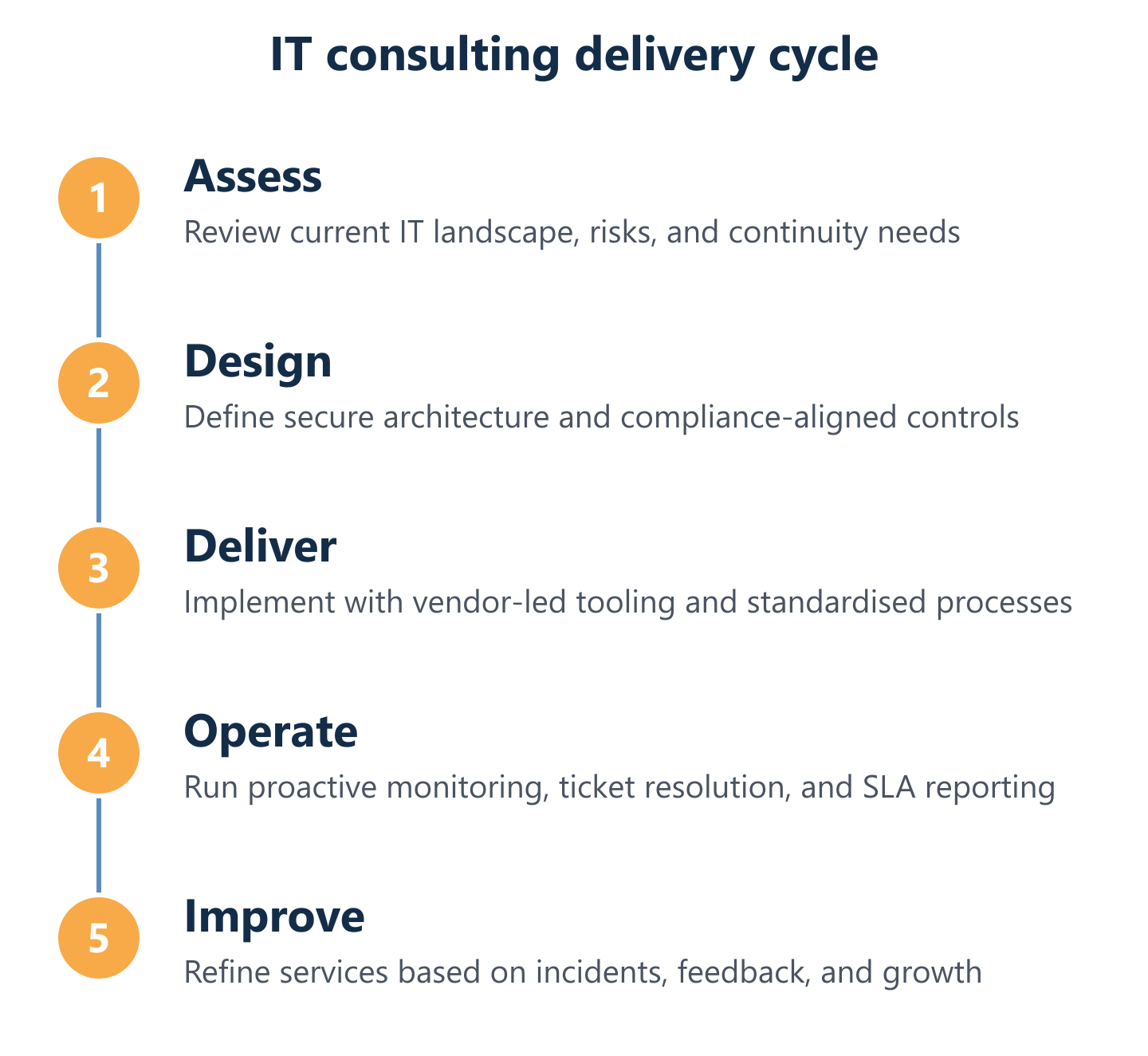
Buyers rarely need a single IT service in isolation. The most effective engagements combine several service lines into a coherent roadmap, sequenced by risk and business priority. The following phases reflect how organisations across Iberia typically structure their IT consulting journey—and how Impulso Tecnológico maps its service set to each stage.
- IT landscape assessment and governance baseline — Audit of current infrastructure, vendor relationships, security posture, and compliance gaps; output is a prioritised risk register and IT roadmap aligned to business objectives.
- IT consulting and outsourcing — Full or partial externalisation of the IT function, covering strategic planning, vendor management, and project execution; frees internal teams to focus on core business while a dedicated partner manages technology decisions and delivery accountability.
- Proactive managed services with SLA-backed monitoring — Continuous system monitoring, preventive maintenance, patch management, and ticket resolution; Impulso Tecnológico resolves over 4,000 IT tickets annually across its active client base, with proactive monitoring designed to surface issues before they affect operations.
- Cybersecurity controls and vendor-led protection — Deployment of endpoint protection, firewall management, access control, and backup and disaster recovery using technologies including Sophos, Fortinet, and Veeam; scope includes GDPR compliance alignment and data protection controls relevant to EU-regulated environments.
- Secure cloud foundations (Microsoft 365 and Azure) — Migration planning, identity management, licensing governance, and ongoing cloud environment management; engagements are structured to deliver scalable, maintainable architectures rather than one-off deployments.
- Infrastructure, networks, and operational security — Design and installation of wired and wireless networks (Cisco, Aruba, Fortinet), access control systems, and video surveillance (Verkada); positioned as part of an integrated risk and continuity plan rather than standalone projects.
- Automation and AI-assisted workflow integration — Process automation using platforms such as Odoo, n8n, and Make.com to reduce manual overhead, integrate cross-platform data flows, and apply intelligent automation to daily operations.
All service components are available under monthly contracts, providing cost predictability and the flexibility to scale scope as the organisation's maturity evolves. Clients work with a single accountable IT partner rather than managing multiple vendors independently.
How to choose an IT consulting provider in Iberia (criteria, proof points, and engagement models)
Selecting an IT consulting partner in Spain or Portugal involves more than comparing service catalogues. The questions that matter most relate to delivery accountability, compliance capability, and whether the provider's model actually fits your organisation's size and operational context. The following criteria provide a practical shortlist framework.
- Local delivery capability: Does the provider offer onsite support in Spain and/or Portugal, or is delivery exclusively remote? For manufacturing, healthcare, and logistics environments, physical presence matters for incident response and infrastructure work.
- Vendor certifications and partnerships: Certified partnerships with vendors such as Microsoft, Cisco, Fortinet, Sophos, and Veeam indicate that the provider can implement and maintain recognised security architectures—not just resell licences. Impulso Tecnológico holds active partnerships across all these vendors.
- GDPR and compliance competence: Any IT consulting engagement touching data infrastructure, cloud environments, or endpoint management in the EU must account for GDPR obligations. Ask specifically how the provider integrates compliance controls into project scope and ongoing managed services.
- Proactive vs reactive service model: Providers that rely solely on ticket-driven support transfer operational risk back to the client. Proactive IT monitoring and ticket management—with defined SLAs—is the baseline expectation for a mature managed services engagement.
- Contract flexibility and cost structure: Rigid multi-year contracts with opaque pricing are a red flag. Monthly contracts with clearly defined service components and SLAs allow organisations to adjust scope as needs change without penalty.
- Engagement model alignment: Advisory-only engagements suit organisations with internal IT teams needing strategic input. Managed services fit those outsourcing day-to-day operations. Project-based delivery works for defined transformation initiatives. The best providers—including Impulso Tecnológico—offer all three and help clients determine which combination is appropriate.
- Verifiable performance indicators: Ask for concrete operational data: ticket volumes handled, client retention figures, and response time benchmarks. These signals separate providers with genuine delivery track records from those offering only credentials.
- Bilingual service delivery: For international organisations operating in Iberia, English-language support capability is a practical requirement, not a differentiator. Confirm it is built into the standard service model, not an add-on.
For further context on how IT consulting and outsourcing services are structured for Spanish and Portuguese businesses, the articles on computer consulting solutions for businesses and IT consulting for digital transformation provide additional detail on service design and delivery models used in practice.
Choosing the right IT consulting partner in Spain or Portugal is a decision with long-term operational consequences. The organisations that achieve consistent results are those that align their IT roadmap with security requirements, compliance obligations, and predictable cost structures from the outset—rather than addressing each element reactively. If your business is ready to move from fragmented IT management to a structured, accountable model, the next step is a tailored assessment of your current environment and a proposal matched to your maturity level and growth objectives. Explore Impulso Tecnológico's integrated IT services or request a direct consultation to begin that conversation.