

IT consulting in Madrid covers the full journey from diagnosing your current technology landscape to delivering and sustaining the systems your business depends on. A qualified partner provides structured assessment, a prioritised technology roadmap, implementation governance, and post-go-live support — not just advice.
Madrid's business environment is technically demanding. Organisations across industry, logistics, professional services, and education face pressure to modernise infrastructure, improve data visibility, and reduce operational risk — often simultaneously. The challenge is not identifying the need for change; it is finding a consulting partner with the methodology, technical depth, and operational continuity to carry projects through from discovery to measurable outcomes.
Impulso Tecnológico has operated from Madrid since 2000, initially as an external IT department for local businesses and later expanding nationwide across Spain and into international markets. With over 25 years of experience, certified engineers, and a vendor-independent approach, we help companies align technology decisions to business objectives — without pushing a single-manufacturer solution. The result is a more stable infrastructure, clearer governance, and IT complexity that stays off your desk.
What IT Consulting in Madrid should deliver (a practical checklist)
A repeatable process, clear deliverables, and structured governance are the minimum bar for any credible IT consulting engagement. Without them, projects drift — budgets expand, timelines slip, and the business is left managing a system it does not fully understand. Before shortlisting providers, use the table below to compare what each partner commits to delivering and at what stage.
| Engagement Phase | Expected Deliverable | What to Check |
|---|---|---|
| Discovery & Assessment | Current-state review, pain point register, data and infrastructure audit | Is scope defined before the engagement starts? |
| Technology Roadmap | Prioritised initiatives, effort estimates, dependency map, success criteria | Does the roadmap align to business objectives or just technology preferences? |
| Implementation Plan | Phased delivery schedule, testing approach, change management plan | Is there a named project owner and escalation path? |
| Governance & Reporting | Steering cadence, risk register, decision log, progress reporting | How often are stakeholders updated, and in what format? |
| Handover & Support | Documentation, training, SLA-backed managed services, incident handling | Is post-go-live support included or a separate contract? |
Impulso Tecnológico operates as an external IT department: we take ownership of technical complexity, align every recommendation to business objectives and budget constraints, and back delivery with proactive monitoring and structured handover. Our managed services model means your teams are not left unsupported once a project closes.
Core deliverables: assessment, roadmap, implementation plan, and handover
Every credible IT consulting engagement begins with a discovery and assessment phase — not a sales presentation. This means a structured review of your current infrastructure, application landscape, data quality, and operational pain points. The output is a documented baseline: what you have, what is not working, and where the highest-risk gaps sit.
From that baseline, the consulting partner builds a prioritised technology roadmap. This is not a wish list; it is a sequenced plan with effort estimates, dependencies, and defined success criteria for each initiative. The implementation plan that follows must include a phased delivery schedule, a testing approach, and a change management component — because technology projects fail more often on adoption than on technical execution. Handover documentation and training close the loop, ensuring your internal teams can operate and maintain what has been built.
Governance and reporting: steering cadence, risk register, and decision logs
Governance is what separates a well-run consulting engagement from a project that quietly loses direction. A structured governance model includes a defined steering cadence — typically fortnightly or monthly senior reviews — a live risk register updated at each checkpoint, and a decision log that records who approved what and when. These artefacts are not bureaucratic overhead; they are the mechanism that keeps scope, budget, and timeline aligned throughout delivery.
For Madrid-based organisations working with external IT consulting partners, clear reporting also reduces dependency on a single consultant. When decisions are documented and risks are visible, the business retains control even if the delivery team changes. Ask any prospective partner to show you a sample governance pack before signing — if they cannot, that is a meaningful signal about how they manage complexity.
Success measurement: KPIs for performance, data, security, and user adoption
Defining KPIs before implementation starts is the only way to measure whether a project has actually delivered value. Performance metrics typically cover system uptime, response times, and incident frequency. Data quality metrics track completeness, accuracy, and latency across integrated sources. Security KPIs monitor vulnerability exposure, patch compliance, and mean time to detect and respond to incidents. User adoption metrics — login rates, feature utilisation, support ticket volume — reveal whether the solution has been embedded in daily operations or quietly bypassed.
Impulso Tecnológico includes monitoring and measurement as part of our managed services model. With over 4,000 IT tickets resolved annually across our client base, we have operational data to inform realistic KPI targets and benchmark performance after go-live. Tracking these indicators continuously, rather than only at project closure, is what turns a successful implementation into a continuously improving system.

ERP, Oracle, BI & advanced reporting: typical engagement scope in Madrid
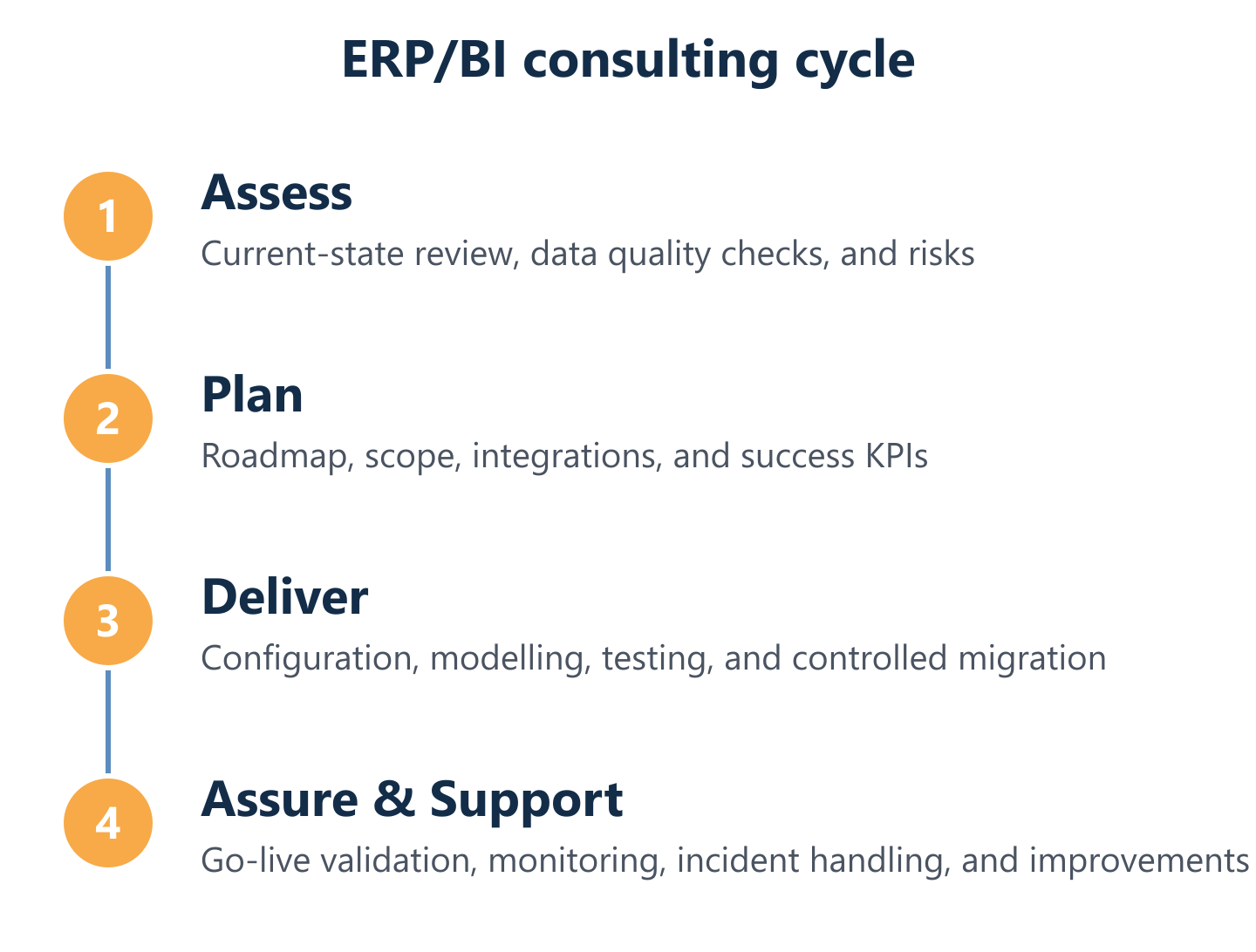
ERP, Oracle, BI, and advanced reporting projects are among the most complex IT consulting engagements a Madrid business will undertake. Each workstream has distinct phases, dependencies, and risk points — and vague proposals that bundle them together without separating scope are a warning sign. Understanding what each stream typically involves helps you ask sharper questions and avoid proposals that promise outcomes without explaining how they will be reached.
- Process mapping and fit-gap analysis: document current business processes, identify gaps between existing workflows and the target ERP or Oracle configuration, and agree on what will be configured versus customised.
- System configuration and integration design: configure the ERP to agreed specifications and design integration points with adjacent systems — finance, HR, logistics, or CRM — with clear data flow documentation.
- Data migration planning: extract, cleanse, transform, and validate legacy data before cutover; define rollback criteria and acceptance thresholds.
- BI and reporting layer: connect validated data sources to a modelling layer, design dashboards aligned to management KPIs, and establish reporting governance so outputs remain accurate over time.
- Testing, training, and go-live: execute unit, integration, and user acceptance testing; deliver role-based training; and manage a controlled go-live with hypercare support in the immediate post-launch period.
- Operational handover: transition to managed services or internal IT with full documentation, defined SLAs, and a continuous improvement backlog.
Impulso Tecnológico complements ERP and BI projects with the operational infrastructure they depend on: managed services, system monitoring, network stability, and security design. As a vendor-independent provider, we recommend solutions based on business objectives and budget — not manufacturer preference — and we deliver in both Spanish and English for smoother adoption across mixed teams.
ERP and Oracle workstreams: fit-gap, integration, migration, and validation
An ERP or Oracle consulting engagement in Madrid typically runs through four tightly connected workstreams. The fit-gap analysis comes first: consultants map current business processes against the target system's standard functionality, producing a gap register that drives configuration and customisation decisions. Integration design follows — documenting how the ERP will exchange data with finance, logistics, HR, or e-commerce platforms, and specifying transformation rules and error-handling logic.
Data migration is where many projects encounter the most risk. Legacy data is rarely clean: duplicates, inconsistent formats, and missing mandatory fields must be resolved before cutover. A controlled migration plan defines extraction scripts, cleansing rules, validation checkpoints, and rollback criteria. Validation — including unit testing, integration testing, and user acceptance testing — closes the workstream and provides the documented evidence that the system meets agreed acceptance criteria before go-live.
BI and reporting workstreams: data sources, modelling, dashboard design, and KPIs
A BI and advanced reporting engagement begins with data source mapping: identifying which systems hold the data needed for management decisions, assessing data quality at source, and agreeing on refresh frequency and latency requirements. The modelling layer — whether a data warehouse, a semantic model, or a direct query structure — must be designed to support both current reporting needs and future analytical questions without requiring a rebuild.
Dashboard design is not a cosmetic exercise. Each visual should map to a defined business KPI, with agreed calculation logic documented and version-controlled. Reporting governance — who owns each report, who can modify it, and how changes are approved — prevents the proliferation of conflicting figures that undermines trust in data. Performance tuning, particularly for large datasets or complex joins, should be part of the scope from the start, not a post-launch fix. BI reporting dashboards that are slow or inconsistent are rarely adopted.
Operational support: monitoring, incident handling, and continuous improvement after go-live
The period immediately after go-live carries the highest operational risk of any ERP or BI project. User confidence is low, edge cases surface that testing did not catch, and the business is running on a system it has not yet internalised. A structured hypercare period — typically two to four weeks of intensive support with defined escalation paths — is not optional; it is the difference between a stable launch and a damaging rollback.
Beyond hypercare, IT managed services and monitoring provide the operational backbone that keeps implemented systems performing. Impulso Tecnológico's managed services model covers proactive monitoring, incident handling, patch management, and continuous improvement cycles — all under guaranteed SLAs. With over 200 large networks managed for small and mid-sized companies, we bring operational depth that pure project consultancies cannot match. Continuous improvement is structured through a backlog reviewed at regular intervals, ensuring the system evolves with the business rather than becoming a static liability.
How to choose the right IT consulting partner in Madrid (and what to ask)
Choosing an IT consulting partner in Madrid is a risk management decision as much as a commercial one. The wrong choice does not just delay a project — it can leave your infrastructure in a worse state than before, with undocumented customisations, unresolved security gaps, and a team that has moved on. A structured evaluation framework reduces that risk significantly.
- Methodology transparency: can the partner describe their assessment, roadmap, and delivery process in concrete steps — not marketing language? Ask for a sample project plan or governance template.
- Vendor independence: does the partner recommend solutions based on your objectives and budget, or do they default to a single manufacturer? Independence matters for long-term flexibility.
- Security integration: is security treated as a workstream within the project, or bolted on at the end? Ask specifically about vulnerability assessment, network hardening, and recovery planning.
- Ongoing support model: what happens after go-live? Is managed services included, optional, or unavailable? Understand the SLA structure and escalation path before signing.
- Contractual flexibility: are contracts rigid and fixed-scope, or can they adapt as your needs evolve? Inflexible arrangements create friction when business priorities shift.
- Language and communication: for Madrid-based international businesses, bilingual delivery (Spanish and English) reduces adoption risk and ensures clearer stakeholder communication.
- Proven operational depth: how many active clients does the partner support? What is their incident resolution volume? Operational track record is a stronger signal than marketing claims.
Impulso Tecnológico differentiates through operational and contractual flexibility: we avoid one-size-fits-all arrangements, centralise IT services under one provider to reduce complexity and cost, and address recurring problems proactively before they affect operations. Our security capabilities include design, implementation, and audit services — including vulnerability and penetration testing — to strengthen confidence at every stage of delivery. You can explore our broader IT consulting approach and our integrated IT services for more detail on how we structure engagements.
Pros and cons of common engagement models: fixed scope vs ongoing managed support
Fixed-scope engagements define deliverables, timeline, and cost upfront. They work well when requirements are stable and the business has the internal capacity to operate the system after handover. The risk is that scope changes — which are common in ERP and BI projects — generate change requests that erode budget and extend timelines. Fixed-scope contracts also create a natural exit point for the consulting partner at go-live, leaving the business without structured support precisely when it is most needed.
Ongoing managed services models provide continuous monitoring, incident handling, and improvement cycles under a predictable monthly cost. They suit organisations that want a single accountable partner across both project delivery and operational stability. The trade-off is a longer-term commitment, which requires confidence in the partner's quality and responsiveness. A hybrid model — fixed-scope delivery followed by a structured managed services agreement — often provides the best balance of cost certainty and operational continuity.
Security and compliance readiness: vulnerability testing, hardening, and recovery planning
Security readiness is not a post-project consideration — it must be integrated into the consulting engagement from the assessment phase. A credible IT consulting partner in Madrid will include network security design, access control review, and endpoint protection as part of the infrastructure workstream, not as optional add-ons.
Vulnerability and penetration testing should be conducted before go-live to identify exploitable gaps in the newly configured environment. Hardening activities — disabling unnecessary services, enforcing least-privilege access, applying patch baselines — reduce the attack surface before the system is exposed to production traffic. Recovery planning, including backup architecture and tested disaster recovery procedures, ensures business continuity if an incident occurs. Impulso Tecnológico works with established security technologies including Sophos, Fortinet, and Veeam, and conducts audit services to validate that controls are effective — not just documented. GDPR compliance is addressed as part of data governance design, not as a separate legal exercise.
Evidence checklist: KPIs, deliverables, timeline assumptions, and acceptance criteria
Before signing with any IT consulting partner in Madrid, request specific evidence across four areas. First, ask for sample deliverables from comparable engagements: a redacted assessment report, a roadmap template, or a dashboard governance document. These reveal whether the partner's outputs are substantive or superficial. Second, ask for the KPIs they have tracked in previous projects and how those were defined — generic metrics like "improved efficiency" are not acceptable; ask for specific indicators with baselines and targets.
Third, challenge their timeline assumptions: what dependencies are assumed, what risks could extend the schedule, and what is the contingency plan? A partner who cannot answer these questions has not planned the project. Fourth, ask how acceptance criteria are defined and who signs off on each phase. Clear acceptance criteria protect both parties and prevent disputes at handover. Our IT consulting success story section and our Madrid IT and communications company page provide additional context on how we structure and evidence our engagements.
The right IT consulting partner in Madrid is not the one with the longest service list — it is the one that can prove a clear method, commit to tangible deliverables, and keep your systems stable long after go-live. Shortlist partners who separate assessment from sales, document governance from day one, and offer a support model that does not disappear at project closure. If a provider cannot show you sample outputs or define success in measurable terms before you sign, that is the answer you need. Technology decisions made with rigour now prevent operational crises later.