

An IT and communications company in Madrid provides integrated services covering infrastructure management, network connectivity, structured cabling, cloud backup, security, and end-user support — all under a single contractual framework designed to keep business operations running without interruption.
Most organisations in Madrid face the same underlying problem: their IT support, network infrastructure, and communications systems are handled by separate providers with no shared accountability. When something breaks at the intersection — a VoIP failure caused by a network misconfiguration, or a security breach that disrupts connectivity — no single vendor owns the resolution. The result is downtime, finger-pointing, and operational risk that compounds over time.
The solution is a provider that treats IT and communications as one discipline, not two separate contracts. This means unified delivery across managed services, cabling, cloud backup, network security, and access control — with clear SLAs and a proactive support model. The measurable result is fewer incidents, faster recovery times, and a technology environment that scales with the business rather than constraining it. Impulso Tecnológico has been delivering exactly this kind of integrated IT and communications service for over 25 years, supporting clients across Spain, Portugal, and 25 countries.
What "IT and Communications" means in Madrid (and why it matters)
The phrase "IT and communications" is used loosely in the market, which creates real problems when businesses try to scope a project or compare providers. In practice, it should mean a single provider capable of designing, deploying, and maintaining the full stack: IT infrastructure, end-user support, network cabling, cloud services, security controls, and the connectivity layer that ties all of it together. When those disciplines are split across vendors, the gaps between them become the source of most incidents.
For businesses in Madrid, this integration matters because operational continuity depends on all layers working in concert. A network outage is not purely a telecom problem; it is an IT problem, a communications problem, and potentially a compliance problem simultaneously. Impulso Tecnológico's model addresses this directly by acting as a single accountable partner across all these domains, backed by proactive SLA-managed services and a partner ecosystem that includes Cisco, Fortinet, Microsoft, and Aruba.
| Capability Area | IT-Only Provider | Telecom-Only Provider | Integrated IT & Communications Provider |
|---|---|---|---|
| End-user device support | ✔ | ✗ | ✔ |
| Structured cabling (data/voice/fibre) | Partial | ✔ | ✔ |
| Cloud backup & disaster recovery | ✔ | ✗ | ✔ |
| Network security & firewall management | ✔ | ✗ | ✔ |
| Access control & video surveillance | ✗ | ✗ | ✔ |
| Unified communications integration | Partial | ✔ | ✔ |
| Single SLA across all services | ✗ | ✗ | ✔ |
Scope overlap: networks, telecom, and IT operations
IT operations cover infrastructure management, cloud services, backup, monitoring, and end-user support. Communications cover voice systems, connectivity, and unified communication services. The overlap — and the source of most operational risk — sits in the network layer, where both disciplines depend on the same physical and logical infrastructure.
Structured cabling, switching, routing, wireless access, and firewall configuration are neither purely IT nor purely telecom; they are shared foundations. A provider that only manages one side of this boundary will inevitably create handover gaps. When a VoIP call drops because of a misconfigured switch, or a cloud backup fails because of a routing issue, the question of who resolves it becomes a contractual dispute rather than a technical fix. Choosing a provider with genuine scope across both disciplines eliminates that ambiguity from day one.
Why "communications" is more than VoIP
Organisations often reduce "communications" to VoIP or a phone system upgrade. In reality, business connectivity and support encompasses far more: the physical cabling infrastructure that carries voice and data, the network security controls that protect those communications, the access control systems that determine who can connect and from where, and the monitoring capabilities that detect anomalies before they become outages.
A single provider that spans all of these removes the handover gaps that cause most incidents. When network security, cabling, cloud services, and end-user support are managed under one SLA, there is no ambiguity about who resolves a problem that crosses boundaries. Impulso Tecnológico's approach — combining IT outsourcing with communications scope — means that a connectivity issue, a security alert, and a device failure are all handled by the same accountable team, with no escalation delays between separate vendors.
Madrid-specific decision drivers: reliability and security
Madrid's business environment places specific demands on IT and communications providers. Organisations operating from the capital — whether in logistics, professional services, industry, or healthcare — require always-on performance: infrastructure that does not fail during business hours, security controls that meet GDPR obligations, and support that responds before an incident escalates into downtime.
The practical goal is measurable: fewer incidents per quarter, faster mean time to resolution, and secure access for staff and customers regardless of location. Providers operating in Madrid also need to demonstrate genuine on-site capability, not just remote support. Impulso Tecnológico offers presential support across Spain, which is particularly relevant for organisations that need physical intervention — cabling work, hardware replacement, or access control installation — without waiting for a technician to travel from another region. That local presence, combined with remote monitoring, is what makes reliability achievable rather than aspirational.

Core services you should expect from a Madrid IT & Communications provider
Not every company that calls itself an IT and communications provider actually delivers the full scope. Before shortlisting vendors, it is worth mapping the capabilities that a credible offering should include — and understanding how each connects to a concrete business outcome. The following list covers the essential service areas, drawn from what organisations in Madrid typically require to maintain operational continuity.
- Managed IT support with fixed monthly pricing per device — unlimited on-site and remote technical assistance with predictable costs and no surprise invoices.
- Structured cabling for data, voice, and fibre optic — physical infrastructure that supports stable connectivity for everyday operations and future capacity growth.
- Cloud-based backup and disaster recovery — automatic, reliable data protection that keeps information accessible even after hardware failure or a ransomware event.
- Network security and access control — firewall management, endpoint protection, and access control systems that enforce who can connect and from where.
- Unified communications integration — ensuring voice, data, and collaboration tools operate on a shared, well-managed network infrastructure.
- Video surveillance and environmental monitoring — physical security layers that complement IT security controls for organisations with regulated or sensitive premises.
- SLA-managed services with proactive monitoring — continuous monitoring, maintenance, and updates that prevent incidents rather than simply responding to them.
Impulso Tecnológico's service scope maps directly to this checklist, supported by a certified partner ecosystem including Sophos, Veeam, Fortinet, Cisco, Aruba, and Microsoft.
IT foundation: managed services, device support, and cloud backup
The IT foundation of any integrated offering rests on three pillars: managed services that keep systems running proactively, device support that resolves end-user issues without delay, and cloud backup that protects data regardless of what happens to local hardware.
Impulso Tecnológico delivers this through a fixed monthly per-device model — a pricing structure that removes the unpredictability of break-fix billing and aligns the provider's incentives with the client's operational stability. Cloud backup is handled using Veeam, one of the most widely trusted platforms for business continuity, ensuring that recovery objectives are met when they matter most. Proactive monitoring means that many issues are identified and resolved before users notice them, which directly reduces the volume of support tickets and the operational disruption they cause. Impulso Tecnológico's own operational data records over 4,000 IT tickets resolved annually across its client base — a volume that reflects genuine managed service delivery at scale.
Communications foundation: cabling, connectivity, and integration readiness
Structured cabling is the physical backbone of every communications system. Without correctly installed, tested, and documented cabling infrastructure — for both computer data networks and voice communication — no software-defined solution will perform reliably. Fibre optic installations extend this foundation to high-bandwidth environments where latency and throughput are critical.
Impulso Tecnológico handles structured cabling for voice and data as part of its integrated service scope, which means that when a client needs to extend their network, add a new office floor, or upgrade to fibre, the same team that manages their IT environment also manages the physical layer. This integration readiness is what enables unified communications integration to work in practice: voice and data traffic share a well-designed, well-maintained infrastructure rather than competing for bandwidth on an ad hoc network. Business connectivity and support built on this foundation is inherently more stable than connectivity bolted onto an existing IT environment by a separate contractor.
Security and compliance enablers: controls, monitoring, and continuity
Network security and access control are not optional layers — they are operational requirements for any organisation handling personal data, financial information, or regulated communications. GDPR compliance in particular requires that access to data is controlled, monitored, and auditable, which means security controls must be integrated with IT operations rather than managed as a separate afterthought.
Impulso Tecnológico deploys network security solutions using Sophos and Fortinet technologies, covering firewall management, endpoint protection, and network segmentation. Access control systems and video surveillance installation — supported through the Verkada platform — extend security to the physical premises, which is particularly relevant for organisations in sectors such as healthcare, logistics, and professional services. SLA-managed services for IT and telecom environments ensure that security configurations are maintained, updated, and monitored continuously, so that compliance posture does not degrade between annual audits. Cloud backup and disaster recovery capabilities complete the continuity picture, ensuring that a security incident does not become a data loss event.
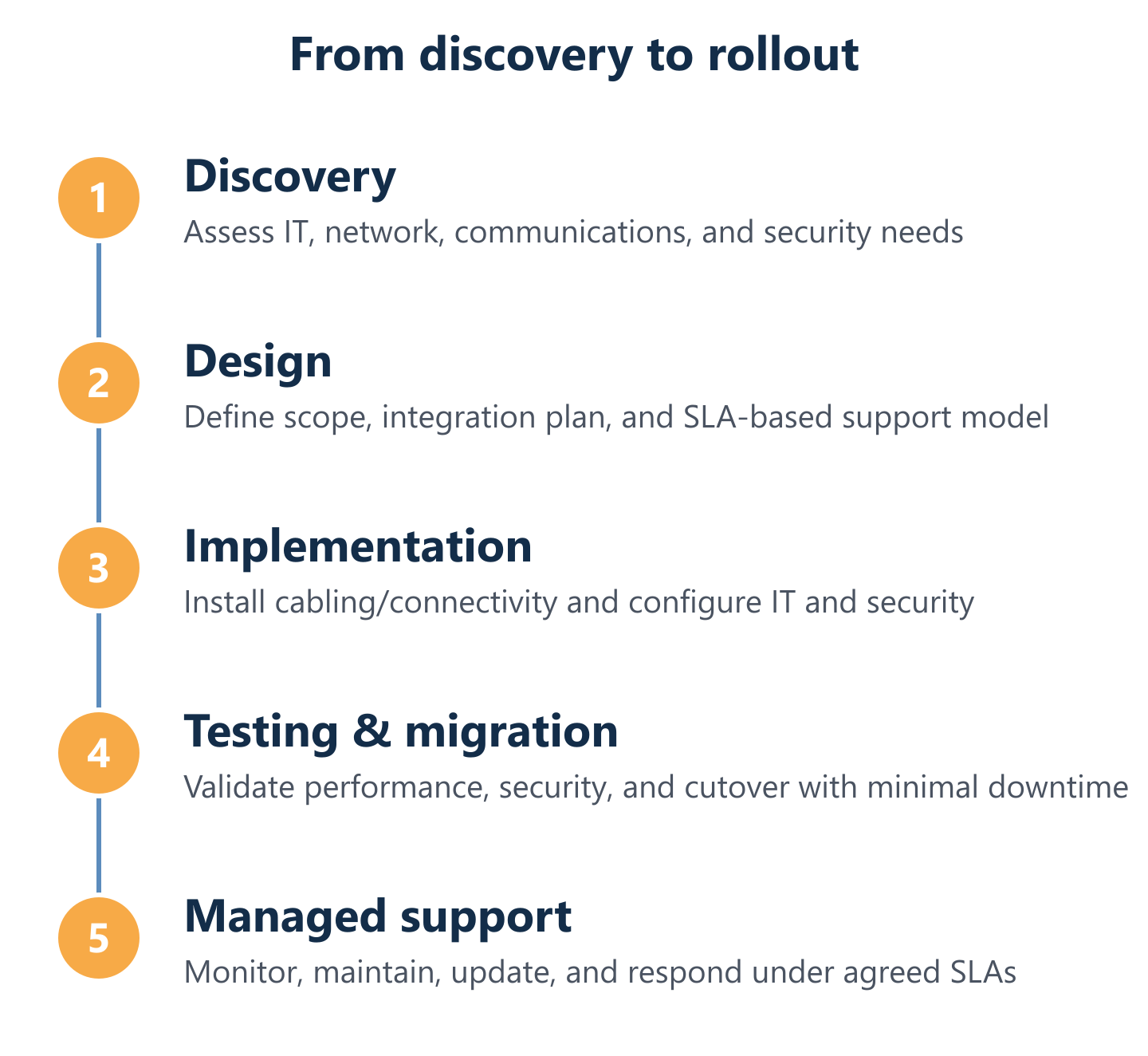
How to evaluate and shortlist companies in Madrid (practical checklist)
Selecting an IT and communications company in Madrid on the basis of price alone is a reliable way to end up with a provider that covers only part of your actual scope. A structured evaluation process — one that tests for genuine capability, contractual clarity, and evidence of delivery — significantly reduces the risk of a mismatched engagement.
The following criteria should form the basis of any shortlisting exercise:
- Scope coverage: Does the provider's service catalogue genuinely cover IT managed services, structured cabling, cloud backup, network security, and communications integration — or does it rely on subcontractors for key elements?
- SLA clarity: Are response times, escalation paths, and resolution targets defined contractually, or are they described only in general terms? SLA-managed services for IT and telecom should specify measurable commitments, not aspirational language.
- Partner ecosystem: Certified partnerships with manufacturers such as Cisco, Fortinet, Microsoft, and Veeam indicate that the provider has validated technical competency, not just commercial relationships.
- On-site capability in Madrid: Remote support is efficient for many issues, but structured cabling, hardware installation, and access control deployment require physical presence. Confirm that on-site technicians are available without long lead times.
- Engagement model flexibility: Avoid providers that only offer rigid, long-term contracts. A proactive managed services model with transparent monthly pricing is a stronger indicator of a provider confident in their own delivery quality.
- Evidence of delivery: Request references from clients in comparable sectors, and ask for operational metrics — ticket volumes, resolution rates, client retention — rather than generic testimonials.
- Integration experience: Ask specifically whether the provider has delivered unified communications integration projects that involved both IT infrastructure changes and physical cabling or connectivity work simultaneously.
Impulso Tecnológico's model is built around exactly these criteria: contractually clear, proactive, and backed by a partner ecosystem that spans the full IT and communications stack. For organisations ready to move forward, the next step is preparing a proposal request with the inputs that generate an accurate scope and timeline.
Commercial fit: scope, engagement model, and SLA-based support
Commercial fit goes beyond price. The engagement model — how a provider structures its contracts, prices its services, and defines its obligations — determines whether the relationship will remain functional under pressure. A provider that charges per incident has no financial incentive to prevent incidents. A provider that offers fixed monthly pricing per device, with proactive monitoring included, is structurally aligned with the client's interest in operational stability.
When evaluating SLA-managed services for IT and telecom, look for specificity: what is the guaranteed response time for a critical outage versus a standard request? What is the escalation path if the first-line team cannot resolve an issue? What happens to SLA commitments during a major incident affecting multiple clients simultaneously? Providers that answer these questions clearly, in writing, before the contract is signed are demonstrating the transparency that long-term partnerships require. Those that defer to "we'll handle it case by case" are signalling that accountability is negotiable.
Evidence and trust signals: references, partner ecosystem, and operational metrics
Trust signals in the IT and communications sector are most meaningful when they are specific and verifiable. Generic claims of "excellent service" carry no weight; operational metrics, certified partnerships, and sector-specific references do.
When validating a provider, request the following: the number of active clients currently under managed service contracts, the volume of support tickets resolved annually (which indicates genuine operational scale), and the names of technology partners with whom they hold certified status. Impulso Tecnológico works with over 476 active clients across 25 countries and resolves more than 4,000 IT tickets annually — figures that reflect a functioning managed service operation rather than a consultancy that handles occasional projects. Certified partnerships with Sophos, Fortinet, Veeam, Microsoft, Cisco, and Aruba provide independent validation of technical competency. For organisations in regulated sectors, also ask about GDPR compliance capabilities and whether the provider has experience supporting clients subject to sector-specific data protection requirements.
Proposal readiness: what to send to get an accurate quote
The quality of a proposal is directly proportional to the quality of the information provided. Sending a vague brief — "we need IT support and better communications" — will generate a vague quote that is impossible to compare objectively. To receive an accurate, actionable proposal from any IT outsourcing with communications scope provider in Madrid, prepare the following inputs before making contact:
- Current infrastructure inventory: number of devices, servers, network switches, and access points in scope.
- Existing cabling and connectivity setup: whether structured cabling is already in place, its age, and any known limitations.
- Current backup and recovery arrangements: what is backed up, how frequently, and where data is stored.
- Security posture: existing firewall, endpoint protection, and access control systems currently in use.
- Business objectives and timeline: what operational outcomes you need to achieve and by when.
- Key stakeholders: who will be involved in the technical evaluation and the commercial decision.
With this information, Impulso Tecnológico can scope a proposal that reflects your actual environment rather than a generic template — and provide a timeline that is realistic rather than aspirational.
Choosing an IT and communications company in Madrid is ultimately a decision about operational risk. Providers that cover only part of the stack — or that lack genuine on-site capability, certified partnerships, or contractually defined SLAs — will create the gaps that cause incidents. If your goal is fewer disruptions, more predictable costs, and a technology environment that supports growth rather than constraining it, the shortlist should be limited to providers that can demonstrate end-to-end delivery across IT infrastructure, connectivity, and security. Impulso Tecnológico's integrated approach, built on over 25 years of managed service delivery, is designed precisely for organisations that cannot afford to treat IT and communications as separate problems. Explore our computer services and IT consulting pages to understand the full scope of what an integrated engagement looks like in practice.