

Computer services cover the full range of IT support, consulting, infrastructure management, and cybersecurity that businesses need to operate reliably. They include both reactive helpdesk support and proactive managed services designed to prevent problems before they affect productivity.
Most organisations reach a point where internal IT resource cannot keep pace with operational demands — systems grow more complex, security threats multiply, and downtime becomes increasingly costly. Relying on ad-hoc support or a single in-house technician leaves gaps in coverage, particularly around monitoring, patch management, and disaster recovery. A structured computer services model closes those gaps by combining preventive maintenance, remote and on-site intervention, and strategic IT consulting under a single accountable provider. The result is a more stable, secure environment where your team can focus on the work that actually drives your business forward.
What "Computer Services" means for your business
The term "computer services" covers a broad spectrum — from fixing a broken laptop to designing resilient data centre architecture. For businesses, the practical definition centres on keeping IT environments operational, secure, and aligned with organisational goals. That means combining day-to-day technical support with strategic consulting, infrastructure management, and security operations.
At Impulso Tecnológico, with over 25 years of hands-on delivery across Spain and internationally, computer services translate into a concrete external IT department model. Rather than selling isolated fixes, the approach integrates consulting, deployment, ongoing support, and security into a coherent service. The measurable outcomes speak to that consistency: 4,000 IT tickets resolved annually and 476 active clients supported across 25 countries.
| Service dimension | Reactive helpdesk | Proactive managed services |
|---|---|---|
| Trigger | User reports a problem | Monitoring detects anomaly before impact |
| Cost model | Variable, per-incident billing | Predictable monthly fee with SLA |
| Security posture | Addressed after breach or failure | Continuous patching, monitoring, and controls |
| Business continuity | Dependent on speed of response | Built into service design (backup, DR, HA) |
| Strategic input | Minimal — focused on resolution | Roadmap, audits, budget planning included |
Computer Services vs IT support vs IT consulting
These three terms are often used interchangeably, but they describe distinct activities. IT support is operational — resolving incidents, replacing hardware, and keeping users productive. IT consulting is strategic — auditing existing systems, designing architecture, and planning technology roadmaps aligned with business objectives. Computer services, as a category, encompasses both: it is the umbrella under which support, consulting, infrastructure deployment, systems audits, and vendor management all sit. Organisations that treat these as separate procurement decisions often end up with fragmented accountability. A single provider covering the full scope — from initial audit to day-to-day managed maintenance — removes that fragmentation and creates a clearer line of responsibility for outcomes.
Managed services: SLAs, onboarding, and day-to-day coverage
Managed IT support shifts the model from reactive to preventive. Instead of waiting for a server to fail, a managed services provider monitors systems continuously, applies patches on schedule, and addresses vulnerabilities before they become incidents. Onboarding typically begins with a structured IT audit — documenting existing infrastructure, identifying risks, and establishing baseline performance metrics. From that point, service delivery is governed by agreed SLAs covering response times, resolution targets, and reporting cadence. For businesses, the commercial benefit is straightforward: predictable monthly costs replace unpredictable emergency spend, and the provider carries accountability for uptime and security outcomes rather than simply billing for hours worked.
What outcomes to expect: uptime, security, and productivity
The clearest measure of effective computer services is reduced unplanned downtime — systems stay available when employees need them, and incidents that do occur are resolved quickly. Beyond availability, a well-structured service delivers measurable security improvements: fewer successful phishing attempts, faster patch deployment cycles, and documented access controls that satisfy audit and compliance requirements including GDPR. Productivity gains follow from both: when IT environments are stable and secure, staff spend less time working around failures or waiting for support. Impulso Tecnológico's multi-layer security approach — combining firewall management, endpoint protection, patch and vulnerability management, secure remote access, and backup — is designed specifically to deliver these outcomes rather than treating each control as an isolated product sale.

Core Computer Services: managed IT, support and monitoring
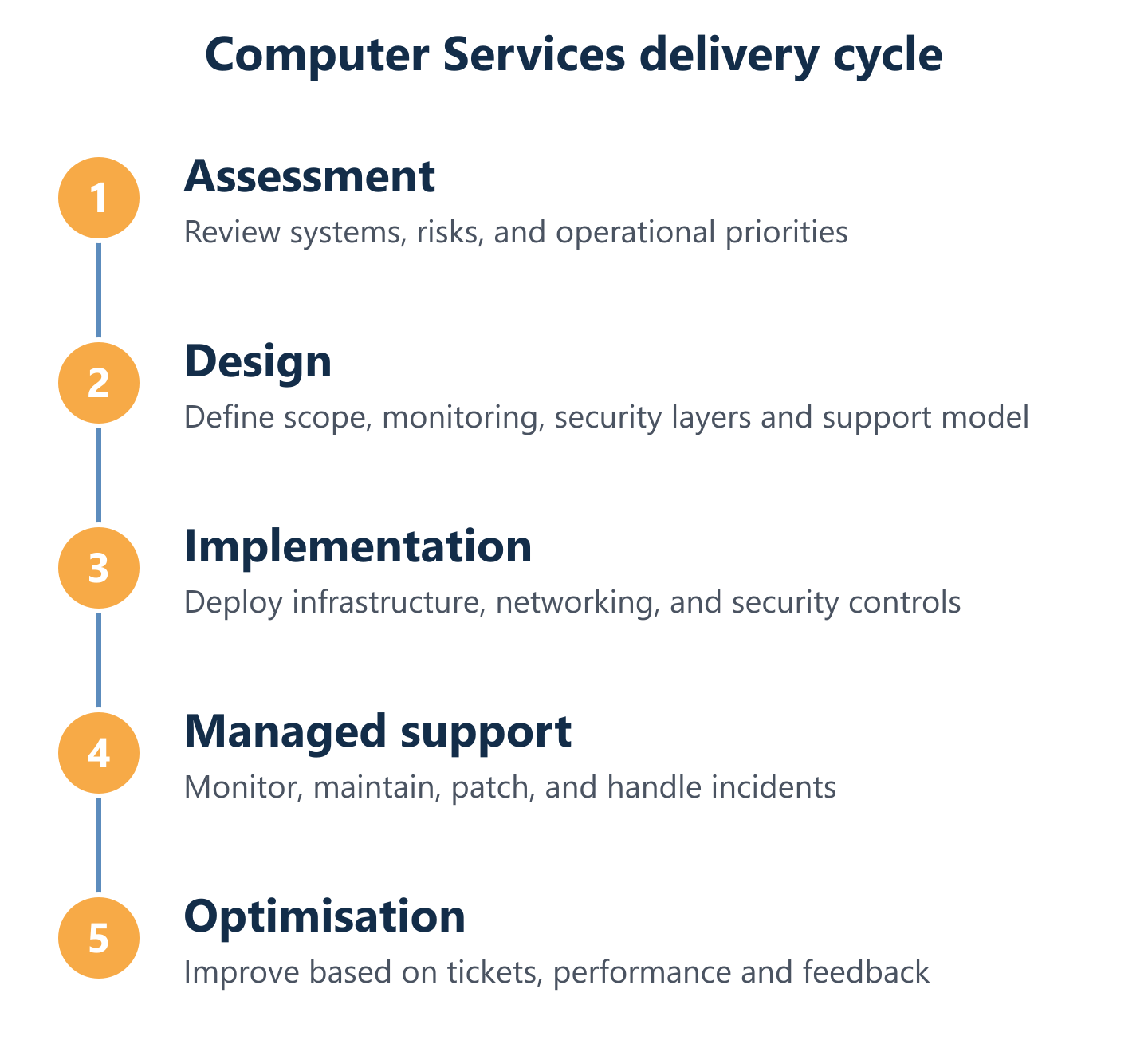
For most organisations, the starting point for outsourced IT is a set of core services that address immediate operational risk: someone to call when things break, monitoring to catch problems early, and maintenance to prevent them accumulating. Structuring this correctly from the outset determines whether IT becomes a stable platform or a persistent source of disruption. At Impulso Tecnológico, the delivery model for core computer services follows a logical sequence:
- Discovery and audit: Document existing infrastructure, identify gaps in coverage, and establish current performance and security baselines.
- Service design: Define the scope of support — which devices, environments, and users are covered — and agree SLA parameters aligned with business continuity requirements.
- Onboarding and tooling: Deploy remote monitoring and management (RMM) tooling, configure alerting thresholds, and establish support channels for end users.
- Ongoing managed support: Deliver remote computer support and on-site IT support as required, with preventive maintenance scheduled to minimise unplanned interruptions.
- Reporting and review: Provide regular service reports covering ticket volumes, resolution times, and system health, feeding into continuous improvement and IT budget planning.
This structured approach is what separates a managed services engagement from ad-hoc break-fix support — and it is the foundation on which more advanced services (infrastructure, cybersecurity, cloud) are built.
Support coverage: desktops, computers, servers and IT environments
Effective business IT support covers the full device and environment stack — not just end-user desktops, but servers, network equipment, storage, and the software environments running on top of them. Remote IT support handles the majority of day-to-day incidents: software faults, configuration issues, access problems, and performance degradation. Where remote resolution is insufficient — hardware failure, physical installation, or complex network faults — on-site IT support provides direct intervention. Impulso Tecnológico operates across Spain with the capability to deploy engineers on-site, and supports clients remotely across Europe, Asia, and the Americas. The objective in both modalities is identical: minimise the time between incident detection and full service restoration, protecting employee productivity and business continuity.
Monitoring and preventive maintenance to reduce downtime
Network monitoring and maintenance is not a background activity — it is the primary mechanism by which managed service providers prevent incidents rather than simply responding to them. Continuous monitoring of server health, disk utilisation, network performance, and security event logs allows anomalies to be addressed before they escalate. Preventive maintenance schedules — covering firmware updates, driver patches, hardware health checks, and log reviews — reduce the accumulation of technical debt that eventually causes unplanned outages. For organisations running mixed environments (on-premise servers alongside Microsoft 365 or Azure workloads), monitoring must span both layers. Impulso Tecnológico's managed maintenance model is designed to cover this hybrid reality, keeping desktops, servers, and cloud-connected systems under consistent oversight.
Service model trade-offs: in-house team vs external IT department
Maintaining a fully in-house IT team gives direct control but carries significant fixed costs: salaries, training, holiday and sickness cover, and the challenge of retaining expertise across an increasingly broad technology stack. An outsourced IT department model — as delivered by Impulso Tecnológico — converts that fixed cost into a scalable service, with access to a multidisciplinary team covering networking, cybersecurity, cloud, infrastructure, and helpdesk support. Critically, the security operations dimension is difficult to staff internally at SME scale: patch management, vulnerability scanning, and penetration testing support require specialist knowledge that most organisations cannot justify hiring full-time. Externalising these functions to a provider with certified expertise in Sophos, Fortinet, and Veeam technologies delivers a materially stronger security posture than a generalist in-house hire.
Infrastructure, networking and cybersecurity under one provider
Consolidating infrastructure, networking, and security under a single computer services provider removes the accountability gaps that emerge when multiple vendors share responsibility for the same environment. When a network fault triggers a security alert, the team investigating it should have full visibility of both layers — not be waiting for a separate supplier to respond. Impulso Tecnológico's delivery scope is built around this integrated model:
- Certified network cabling: Design and installation of structured data, voice, and fibre optic cabling across Spain, delivering the physical foundation that wireless and cloud services depend on.
- Wireless and wired networking: Deployment and management of enterprise networking using Cisco, Aruba, and Fortinet technologies, covering both office environments and multi-site organisations.
- Communications infrastructure: Installation and support of telephone systems (PBX and VoIP), enabling organisations to modernise communications at their own pace.
- Multi-layer cybersecurity: Rather than a single firewall-and-antivirus approach, the security model covers local network attack blocking, endpoint protection, patch and vulnerability management, penetration testing support, secure remote access (VPN), and GDPR-aligned backup and compliance controls.
- Physical security integration: CCTV and access control solutions (including Verkada), and environmental monitoring systems for server rooms and critical infrastructure.
- Energy resilience: UPS and power management solutions (Schneider Electric / APC) to protect infrastructure from power disruption.
For organisations evaluating providers, the practical question is whether a single partner can cover this breadth without compromising depth. Impulso Tecnológico's certified partnerships with Sophos, Fortinet, Veeam, Cisco, Aruba, Microsoft, and others provide the technical depth behind the integrated service model.
Infrastructure and data centre services: design, deployment and migrations
Infrastructure projects — whether building a new server environment, migrating from on-premise to cloud, or consolidating data centres — require careful planning before a single cable is run. Impulso Tecnológico's approach begins with a dimensioning consultation: understanding current workloads, growth projections, availability requirements, and budget constraints before recommending architecture. Deployment then covers server installation and configuration (Windows Server and Linux environments), virtualisation, storage, and connectivity. For organisations requiring high availability, the design incorporates redundancy at the hardware, network, and data layers. Migrations — whether to Microsoft Azure, a hybrid cloud model, or between physical sites — are planned to minimise service disruption, with rollback procedures defined before cutover. Energy resilience, including UPS systems, is factored into data centre design from the outset.
Networking and communications: certified cabling and secure connectivity
A reliable network is the prerequisite for every other IT service — cloud connectivity, VoIP, remote access, and security monitoring all depend on physical and logical network integrity. Impulso Tecnológico delivers Computer Network Cabling services throughout Spain, covering the design and installation of certified structured cabling for data, voice, and fibre optic applications. For wireless environments, enterprise-grade access point deployment using Cisco and Aruba equipment ensures consistent coverage and security segmentation. On the communications side, telephone system installation and support spans traditional PBX through to modern VoIP platforms, allowing organisations to transition without disrupting existing workflows. Secure connectivity — including VPN configuration and remote access management — is treated as part of the network layer rather than a separate security product, ensuring consistent policy enforcement across all connection types.
Cybersecurity, backup and disaster recovery: layered protection and HA
A firewall and antivirus combination is not a security strategy — it is a starting point. Impulso Tecnológico's approach to cybersecurity within its computer services model is explicitly multi-layer: blocking network and endpoint-based attacks, removing vulnerabilities through structured patch management and penetration testing support, controlling authorised access via VPN and identity management, and ensuring business resilience through backup and disaster recovery. Backup and disaster recovery planning uses Veeam technology, covering both on-premise and cloud-connected environments, with recovery objectives defined against actual business continuity requirements rather than generic defaults. For organisations with high availability requirements, the architecture incorporates replication and failover mechanisms. Firewall management — primarily WatchGuard, selected for versatility, stability, and cost-effectiveness — is included as a managed service rather than a one-time installation, ensuring configurations remain current as threat landscapes evolve.
Selecting a computer services provider is ultimately a decision about accountability — who is responsible when systems fail, and what structured process exists to prevent failure in the first place. The strongest providers combine technical depth across infrastructure, networking, and security with a delivery model that is transparent, measurable, and genuinely responsive to your operational context. If you are evaluating options, compare providers on service coverage breadth, delivery methodology, certified partnerships, and the quality of their onboarding and audit process. Impulso Tecnológico offers an initial consultation to assess your current IT environment and identify the most impactful areas for improvement — a practical first step before any commitment is made. You can also explore our computer consulting services, learn more about our IT services, or review how we work as a national IT company supporting businesses of all sizes.