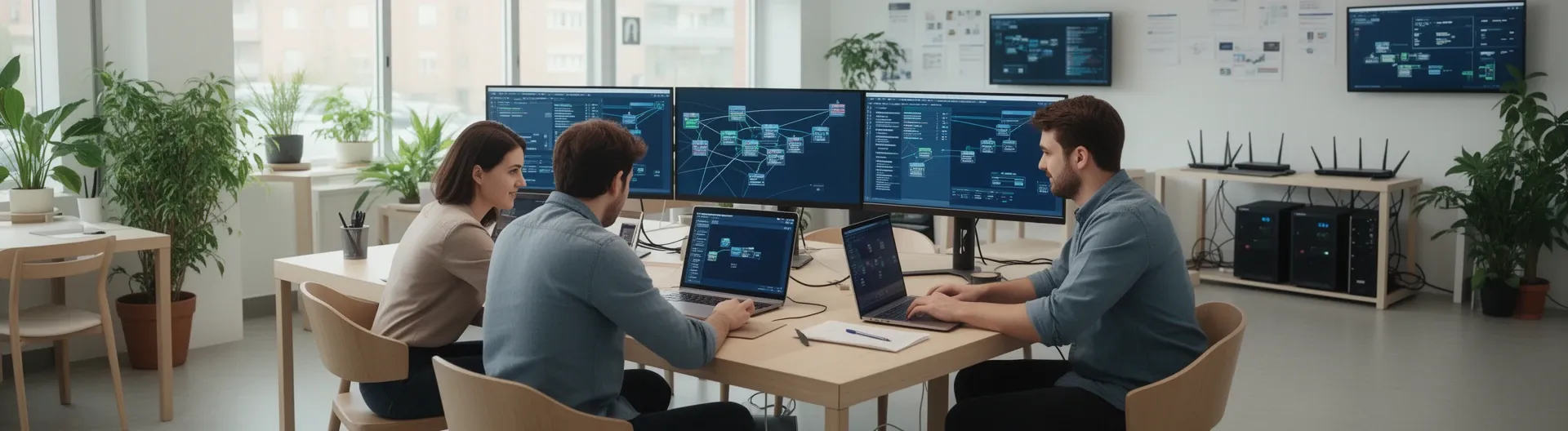

IT maintenance in Colmenar Viejo means keeping every device, server, and network connection in your business running reliably — with a defined scope, a fixed monthly cost, and a team that responds before small issues become costly outages.
Many businesses in Colmenar Viejo operate with lean internal teams that cannot absorb the time or expertise required to maintain modern IT infrastructure properly. Servers accumulate missed updates, backups go untested, and network security sits unreviewed until something fails. The result is unplanned downtime, data exposure, and reactive spending that far exceeds what a structured maintenance contract would cost. Impulso Tecnológico addresses this directly: with more than 25 years of managed IT experience across Spain, Portugal, and international markets, we run maintenance as a proactive, accountable service — not a break-fix arrangement. Businesses in Colmenar Viejo gain a single point of responsibility for devices, connectivity, security, and cloud services, with clear reporting and predictable costs every month.
IT Maintenance in Colmenar Viejo: what it actually includes
Signing an IT maintenance contract without a clear scope definition is one of the most common mistakes SMEs make. "Maintenance" can mean anything from replacing a broken keyboard to managing a full server environment — and the difference in value is enormous. For offices and businesses in Colmenar Viejo, a well-structured IT maintenance service should cover the full technology stack that keeps daily operations running: end-user devices, servers, network infrastructure, cloud services, and the security layer that protects all of them.
At Impulso Tecnológico, we define maintenance as a managed service with proactive responsibility. That means we do not wait for a call to act — we monitor, update, and audit continuously. Our team resolves thousands of IT tickets annually across our client base, and we track client satisfaction as a performance indicator to ensure service quality does not drift. For businesses in Colmenar Viejo, this translates into fewer disruptions, faster resolution times, and a single provider accountable for the entire IT environment.
| Maintenance area | Typically included | Often excluded (check your contract) |
|---|---|---|
| End-user devices (PCs, laptops) | Updates, troubleshooting, OS support | Hardware replacement parts |
| Servers and storage | Health checks, patching, monitoring | Physical hardware upgrades |
| Network infrastructure | Switch/router monitoring, connectivity support | Structured cabling installation (project scope) |
| Cloud services (Microsoft 365 / Azure) | Licence management, user administration | Custom development or migration projects |
| Security controls | Firewall management, endpoint protection | Penetration testing or compliance audits |
| Backup and recovery | Backup configuration, monitoring, test restores | Large-scale disaster recovery projects |
Scope checklist: what should be covered (and what shouldn't)
A reliable IT maintenance contract specifies exactly which assets fall within scope. Before signing, confirm coverage across these categories: workstations and laptops (number of devices, operating systems); servers (physical and virtual); network devices (switches, routers, access points, firewalls); cloud environments (Microsoft 365, Azure, or third-party platforms); user accounts and access management; and backup systems. Equally important is what sits outside the contract — hardware procurement, new infrastructure projects, and software licensing costs are typically separate. Impulso Tecnológico defines scope clearly at the outset, so clients in Colmenar Viejo know precisely what is covered, what triggers an additional quote, and where responsibility lies. Ambiguity in scope is the primary cause of disputes and unexpected invoices in IT maintenance relationships.
On-site and remote support model: how response is handled
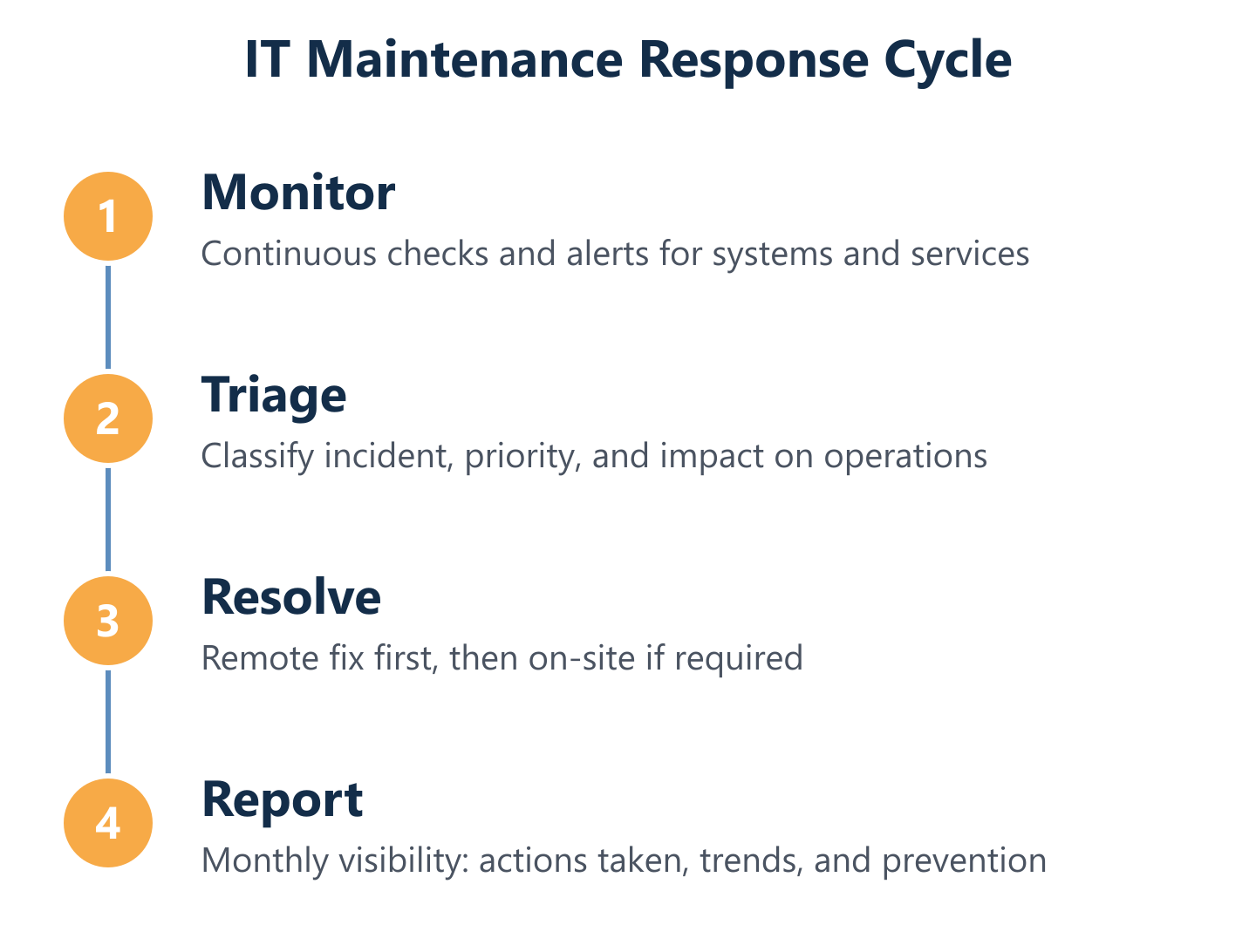
Effective IT maintenance separates two distinct types of work: scheduled proactive tasks (updates, health checks, backups verification) and reactive corrective response (fault diagnosis, incident resolution). Both require a defined response model. Remote support handles the majority of day-to-day incidents quickly and cost-effectively — software faults, user access issues, and cloud configuration problems rarely need a technician on-site. However, hardware failures, network cabling faults, and physical infrastructure issues require physical presence. Impulso Tecnológico combines both modalities for clients in Colmenar Viejo: remote resolution for speed, on-site intervention when the fault demands it. This hybrid model avoids the delays of remote-only providers and the unnecessary cost of sending a technician for every minor ticket. Our IT maintenance contracts for SMEs define response priorities so critical systems get attention first.
Visibility and reporting: what you receive each month
Maintenance without reporting is maintenance you cannot evaluate. A professional IT maintenance contract should deliver regular visibility into what has been done, what was found, and what requires attention. At minimum, monthly reporting should include: a summary of incidents opened and resolved, the status of scheduled preventive tasks (patches applied, backups verified, health checks completed), any alerts triggered by monitoring tools, and recommendations for the coming period. Impulso Tecnológico provides clients with clear communication and performance tracking as standard — not as an add-on. This accountability matters particularly for SMEs in Colmenar Viejo that do not have an internal IT manager to oversee the provider. Reporting transforms maintenance from a cost centre into a measurable business function with documented outcomes and forward-looking recommendations.

Preventive vs corrective maintenance: reducing downtime
Every hour of unplanned downtime costs a business in lost productivity, delayed operations, and — in some cases — reputational damage with clients. The distinction between preventive and corrective maintenance is not academic: it directly determines how often your systems fail and how quickly they recover when they do. Preventive maintenance eliminates the conditions that cause failures; corrective maintenance resolves failures that occur despite prevention. A mature IT maintenance plan uses both, with preventive work reducing the volume of corrective incidents over time.
Impulso Tecnológico structures maintenance to prioritise prevention without ignoring the reality that incidents still happen. Our approach aligns support activities to business priorities — critical systems receive more frequent checks and faster response windows. The result is a measurable reduction in recurring faults and a faster mean time to resolution when something does go wrong.
- Asset inventory and baseline: Document every device, server, and network component so nothing falls outside the maintenance perimeter.
- Scheduled preventive tasks: Apply OS and firmware updates, run automated health checks, verify backup integrity, and review security configurations on a defined calendar.
- Continuous monitoring: Deploy monitoring agents that generate alerts when performance thresholds, availability, or security indicators deviate from baseline.
- Incident triage: When an alert or user report arrives, classify by severity and route to the appropriate response channel — remote or on-site.
- Resolution and root-cause review: Resolve the fault, document the cause, and update the preventive schedule if the incident reveals a gap in coverage.
- Monthly review: Analyse incident patterns, pending recommendations, and upcoming risks to keep the maintenance plan current.
Preventive maintenance examples: updates, health checks, and housekeeping
Preventive maintenance is the work that happens before users notice a problem. Typical activities include: applying Windows and third-party software patches on a regular cycle to close security vulnerabilities; running disk health diagnostics to identify drives approaching failure before data is lost; clearing temporary files and reviewing startup processes to maintain device performance; verifying that backup jobs completed successfully and that recovery points are valid; reviewing firewall rules and access control lists for outdated entries; and checking server event logs for warning-level entries that precede failures. Impulso Tecnológico schedules these tasks systematically across client environments, ensuring nothing is skipped because a technician was busy with reactive work. For businesses in Colmenar Viejo, this discipline translates directly into fewer emergency calls and longer hardware lifespans.
Corrective maintenance workflow: triage, escalation, and resolution
When a fault occurs, the quality of the corrective response depends on having a defined workflow rather than improvising under pressure. A structured corrective maintenance process starts with triage: classify the incident by impact (is a critical system down, or is one user affected?) and by type (hardware, software, network, or security). High-impact incidents escalate immediately to senior technicians; low-impact issues enter a standard queue. Remote diagnosis is attempted first to minimise response time. If remote resolution is not possible, on-site attendance is dispatched. Throughout the process, the client receives status updates so operations can plan around the outage. Impulso Tecnológico applies this workflow across all client environments, ensuring that a fault in a Colmenar Viejo office receives the same structured response as any other location in our managed services portfolio.
Pros and cons: when each approach matters most
Preventive maintenance delivers the highest return in stable, well-documented environments where assets are known and schedules can be followed. Its limitation is that it cannot eliminate all failures — hardware fails unpredictably, and user behaviour introduces variables no schedule can anticipate. Corrective maintenance is unavoidable, but relying on it exclusively is expensive: reactive support costs more per incident than scheduled work, and downtime accumulates. The optimal IT maintenance plan for an SME in Colmenar Viejo combines both: a defined preventive programme that reduces incident frequency, and a corrective response process with clear SLAs that limits the duration of outages when they occur. Impulso Tecnológico builds both layers into every IT maintenance contract, so clients are not choosing between prevention and response — they receive both as a single managed service.
Security, backups and monitoring: the maintenance that protects data
Security and backup management are not optional add-ons to IT maintenance — they are the components that determine whether a business survives a serious incident. Ransomware attacks, hardware failures, and accidental deletions are not hypothetical risks for SMEs; they are documented, frequent occurrences. An IT maintenance contract that excludes security controls and backup verification is incomplete by definition.
Impulso Tecnológico integrates security and resilience into maintenance as standard. We work with established technology partners — including Sophos, Fortinet, and Veeam — to deliver layered protection that covers endpoints, network perimeter, and data recovery. This is not a separate security project; it is part of the ongoing managed service that keeps client environments in Colmenar Viejo protected continuously.
- Endpoint protection: Anti-malware and anti-ransomware agents deployed and monitored on all devices within scope, with definitions updated automatically.
- Perimeter security: Firewall configuration management using Fortinet or Sophos solutions, with rule reviews included in the maintenance cycle.
- Backup configuration and monitoring: Automated backup jobs for servers and critical data, with daily status checks and periodic test restores to confirm recovery readiness.
- Access control: User account reviews, password policy enforcement, and VPN configuration management to limit exposure from compromised credentials.
- Weekly alert supervision: Monitoring dashboards reviewed on a defined cadence so anomalies are caught before they escalate into incidents.
- SSL and certificate management: Expiry tracking and renewal to prevent service interruptions caused by lapsed certificates.
Proactive monitoring and response: escalation without chaos
Monitoring without a defined escalation process generates noise, not protection. Effective proactive monitoring means deploying agents on servers, network devices, and endpoints that report availability, performance, and security events to a centralised platform. Alerts are classified by severity: a server CPU running at 95% for ten minutes is different from a backup job failing silently for three weeks. Impulso Tecnológico configures alert thresholds based on each client's environment and business criticality, so the team receives actionable notifications rather than alert fatigue. When a threshold is breached, the escalation path is predefined — the right technician is notified, the client is informed, and a resolution timeline is set. Weekly monitoring reviews ensure that low-priority alerts accumulate into a structured report rather than being ignored.
Backups as a standard: configuration, testing, and recovery readiness
A backup that has never been tested is not a backup — it is an assumption. Backup management within an IT maintenance contract must cover three distinct activities: configuration (defining what is backed up, how frequently, and to which destination — local, cloud, or both); monitoring (verifying that backup jobs complete successfully and that no silent failures accumulate); and recovery testing (periodically restoring data from backup to confirm that files are intact and recovery time is within acceptable limits). Impulso Tecnológico uses Veeam as a primary backup and disaster recovery platform for server environments, combined with cloud-based backup solutions for endpoint and Microsoft 365 data. For businesses in Colmenar Viejo, this means that a ransomware event or hardware failure does not result in permanent data loss — it results in a controlled recovery from a verified restore point.
Security in scope: firewalls, anti-malware, and access protection
Perimeter security and endpoint protection require ongoing management, not one-time configuration. Firewall rules accumulate over time — old entries for departed staff, obsolete services, and legacy applications create gaps that attackers exploit. Anti-malware solutions need policy reviews, not just automatic updates. Access control lists require regular audits to ensure that only current employees hold active credentials with appropriate permissions. Impulso Tecnológico manages these security controls as part of the maintenance contract, using Sophos for endpoint protection and Fortinet for network perimeter security across many client environments. For businesses seeking managed cybersecurity in Colmenar Viejo, this integration means security is maintained continuously rather than reviewed annually after an incident. Our approach to network security maintenance covers both the technical controls and the operational discipline required to keep them effective. You can also explore how we approach preventive IT maintenance for businesses as a structured methodology.
Choosing the right IT maintenance model for your business in Colmenar Viejo comes down to three things: a clearly defined scope that leaves no asset unmanaged, a support structure that combines proactive prevention with fast corrective response, and integrated security and backup management that protects your data continuously. Impulso Tecnológico delivers all three under a single managed service contract — with flexible arrangements, clear reporting, and a team with over 25 years of experience supporting businesses across Spain and beyond. If you are comparing providers or reviewing your current IT maintenance contract, see how we structure IT maintenance in nearby Arganda del Rey or review our IT support model in Alcobendas for reference. Contact us to discuss the scope that fits your environment.